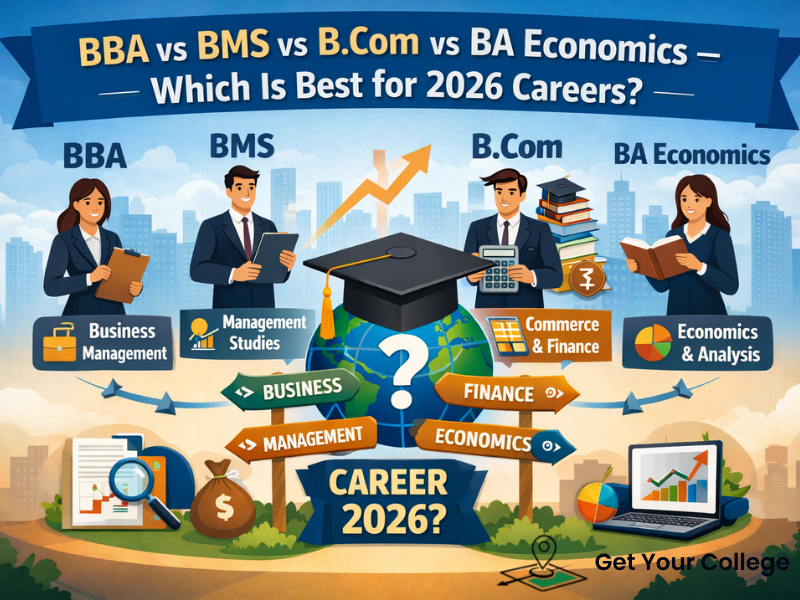
Choosing the right undergraduate degree after Class 12 is no longer just an academic formality—it is a career-defining decision that can shape your professional journey for decades. Among commerce and humanities students, four undergraduate programs consistently create confusion and debate: BBA, BMS, B.Com, and BA Economics.
At first glance, these degrees may appear similar. All are respected, all offer strong career opportunities, and all can lead to postgraduate studies. However, in reality, they differ significantly in curriculum structure, skill development, career outcomes, salary potential, global relevance, and future scope.
With the job market rapidly transforming due to artificial intelligence, automation, data analytics, globalisation, remote work models, and evolving corporate structures, what worked even five years ago may no longer be sufficient in 2025 and beyond. Students today must choose courses not based on popularity or peer pressure, but on skills, employability, adaptability, and long-term growth.
This comprehensive guide compares BBA vs BMS vs B.Com vs BA Economics across every critical dimension—curriculum, learning style, career paths, salaries, higher education options, future scope, and suitability—to help you decide which course is truly best for your career in 2025.
Earlier generations selected degrees primarily based on:
Board exam marks
College reputation
Family expectations
Peer influence
In contrast, employers in 2025 and beyond prioritise:
Practical and job-ready skills
Analytical and problem-solving ability
Business and economic understanding
Adaptability to new technologies
Continuous learning mindset
Low employability
Career stagnation
Multiple degree changes
Skill mismatch with the job market
Delayed financial independence
Faster career growth
Higher long-term salary potential
Better postgraduate opportunities
Global career mobility
Strong professional identity
The decision you make at the undergraduate level can influence your income, job satisfaction, global exposure, and career stability for the next 20–30 years.
Before comparing them in depth, it is essential to understand what each course fundamentally represents.
A professional, management-oriented degree designed to prepare students for corporate roles, entrepreneurship, and MBA programs. BBA focuses on building business acumen, leadership skills, and managerial thinking at an early stage.
A management-intensive academic program with a stronger emphasis on strategy, leadership, organisational behaviour, and decision-making frameworks. BMS is often more theory-driven and conceptually rigorous than BBA.
A commerce and finance-focused degree centred on accounting, taxation, finance, economics, auditing, and business law. It forms the backbone for professional qualifications like CA, CMA, and CS.
An analytical and data-driven degree that focuses on economic theory, statistics, econometrics, public policy, and quantitative analysis. BA Economics is highly valued in analytics, research, policy, and global careers.
Course | Primary Focus | Learning Style | Skill Orientation |
|---|---|---|---|
BBA | Business & Management | Practical, application-based | Managerial & leadership |
BMS | Strategic Management | Theory + case studies | Decision-making & strategy |
B.Com | Commerce & Finance | Numerical, academic | Accounting & finance |
BA Economics | Economics & Data | Analytical, research-oriented | Data & policy analysis |
Marketing Management
Human Resource Management
Financial Management
Operations & Supply Chain Management
Entrepreneurship Development
Business Analytics
Organizational Behavior
Business Communication
Strong industry relevance
Early exposure to corporate environments
Excellent foundation for MBA and PGDM
Encourages leadership, teamwork, and decision-making
High demand in private sector jobs
Management Trainee
Marketing Executive
HR Executive
Sales & Business Development Executive
Business Analyst (entry-level)
Operations Executive
Startup Founder
MBA (India or abroad)
Students interested in business and management
Those planning for an MBA
Students with good communication and interpersonal skills
Aspiring entrepreneurs and corporate professionals
Limited depth in accounting and taxation
Salary growth depends heavily on an MBA or specialisation
Requires strong internships to stand out
Management Theory
Business Strategy
Corporate Governance
Operations Management
Leadership & Ethics
Research Methodology
Organizational Design
Strategic Analysis
Strong conceptual and theoretical clarity
Ideal for strategy, consulting, and leadership roles
Excellent preparation for top-tier MBA programs
Develops critical thinking and analytical reasoning
Business Analyst
Strategy Executive
Management Consultant (entry-level)
Operations Manager (junior)
Corporate Analyst
MBA / PGDM
Students interested in strategy and leadership
Those comfortable with theory and case studies
Students aiming for top B-schools
Learners who enjoy conceptual depth
Less hands-on exposure compared to BBA
Fewer colleges offer BMS
Limited accounting and finance depth
Financial Accounting
Cost & Management Accounting
Taxation (Direct & Indirect)
Auditing
Business Law
Corporate Finance
Economics
Financial Markets
Strong base for CA, CMA, CS
Highly relevant for banking, finance, and accounting roles
Widely accepted degree in India and abroad
Flexible degree with many specialisation options
Accountant
Tax Consultant
Financial Analyst
Banking Professional
Accounts Executive
Investment Analyst (with further study)
CA / CMA / CS / MBA
Students are strong in numbers and calculations
Those aiming for professional finance courses
Candidates interested in banking, accounting, and taxation
Less focus on leadership and management
Average salaries without professional certifications
More academic than skill-based at the UG level
Microeconomics & Macroeconomics
Statistics & Econometrics
Mathematical Economics
Development Economics
Public Policy & Governance
International Economics
Data Analysis & Interpretation
Strong analytical, quantitative, and data skills
High demand in analytics, research, policy, and finance
Excellent base for international master’s programs
Strong relevance in AI-driven and data-based roles
Data Analyst
Economic Analyst
Policy Researcher
Financial Analyst
Research Associate
Consultant (with further study)
MSc Economics / MBA / Public Policy
Students who enjoy math, statistics, and analysis
Those aiming for global or research careers
Candidates interested in policy, data, and economics-driven roles
Academically demanding
Less direct corporate exposure at the UG level
Postgraduate study is often required for top roles
Course | Average Starting Salary (₹ per annum) |
|---|---|
BBA | 3 – 6 LPA |
BMS | 3.5 – 6.5 LPA |
B.Com | 2.5 – 5 LPA |
BA Economics | 4 – 8 LPA |
Note: Salaries depend heavily on college quality, internships, skills, and further education.
Course | Long-Term Growth Potential | Global Scope |
|---|---|---|
BBA | High (with MBA) | Medium |
BMS | High (with MBA) | Medium |
B.Com | Very High (with CA/CFA) | High |
BA Economics | Very High | Very High |
You want early corporate exposure
You plan to pursue an MBA
You prefer practical learning
You are inclined towards strategy and leadership
You aim for top management roles
You enjoy theoretical depth
You want finance, accounting, or CA
You are strong in numbers
You prefer stable, professional careers
You want analytics, data, or policy roles
You plan for higher studies abroad
You enjoy economics and statistics
In the coming decade:
BBA & BMS graduates will benefit from AI-powered management and consulting roles
B.Com will remain crucial due to financial regulation, compliance, and auditing.
BA Economics will dominate in data analytics, policy research, and economic consulting.g
There is no single best course for everyone. The best course is the one that aligns with your aptitude, interests, and long-term career vision.
Do not choose a degree based on:
Trends alone
Peer pressure
College brand only
Choose based on:
Your aptitude
Career goals
Skill alignment
Future opportunities
A well-chosen undergraduate degree can shape your career for the next 20–30 years.
This guide is prepared by Get Your College, a student-focused education platform dedicated to providing accurate, research-driven, and unbiased guidance on courses, careers, universities, and admissions, empowering students to make confident academic decisions for a successful future.