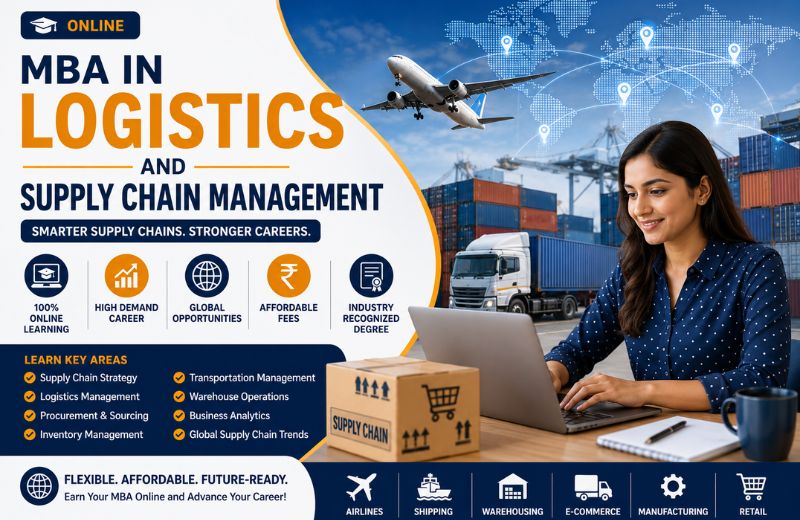
An MBA in Logistics and Supply Chain Management Online is designed for students and working professionals who want to build expertise in supply chain operations while enjoying the flexibility of online learning. As global trade, digital commerce, and automation continue expanding, demand for skilled supply chain managers is increasing rapidly across industries.
This comprehensive guide covers everything you need to know about an Online MBA in Logistics and Supply Chain Management, including eligibility, fees, admission process, syllabus, career scope, salary potential, benefits, latest trends, and future opportunities.
The admission process for the MBA in Aviation Management is designed to select candidates who have the academic qualifications, management aptitude, and interest required to succeed in the aviation industry. Most institutions follow a structured admission procedure that includes entrance examinations, application submission, and selection rounds.
Step 1: Complete Graduation
The first step is to complete a bachelor's degree from a recognised university. Students from various academic backgrounds, such as Commerce, Science, Arts, Engineering, and Management,t can apply for the program.
Basic Requirement:
Bachelor's degree from a recognised institution
Minimum 50% aggregate marks (may vary by college)
A strong academic record can improve the chances of admission to reputed aviation management colleges.
Step 2: Appear for Entrance Exams
Most colleges consider entrance exam scores as an important part of the admission process. These exams evaluate a candidate's analytical ability, communication skills, logical reasoning, and management aptitude.
Accepted Entrance Exams
CAT (Common Admission Test)
One of India's most popular MBA entrance exams, CAT is accepted by many top management institutions offering aviation management programs.
MAT (Management Aptitude Test)
MAT is widely accepted by numerous private and public management colleges across India.
XAT (Xavier Aptitude Test)
XAT evaluates decision-making ability, analytical skills, and management aptitude.
CMAT (Common Management Admission Test)
CMAT is a national-level examination accepted by many AICTE-approved institutions.
SNAP (Symbiosis National Aptitude Test)
SNAP is conducted for admission to Symbiosis institutes and management programs.
University-Specific Entrance Tests
Many universities conduct their own entrance examinations for MBA admissions.
A higher entrance exam score generally improves admission opportunities.
Step 3: Submit Application
After qualifying for the entrance examination, candidates must submit their application through the institution's admission portal.
Application Process
Students are typically required to provide:
Academic records
Entrance exam scorecards
Identity proof
Passport-size photographs
Application form
Application fee
Submitting accurate information and documents is essential for successful application processing.
Step 4: Group Discussion and Interview
Many colleges conduct additional selection rounds to evaluate a candidate's communication skills, personality, and management potential.
Group Discussion (GD)
During the GD round, students discuss current topics or business-related issues in a group setting.
Assessment Areas:
Communication Skills
Teamwork Ability
Leadership Qualities
Critical Thinking
Problem-Solving Skills
Personal Interview (PI)
The personal interview helps institutions understand the candidate's career goals and suitability for the program.
Common Evaluation Factors:
Academic Background
Aviation Industry Awareness
Career Objectives
Leadership Potential
Confidence and Communication
Strong performance in GD and PI rounds can significantly improve the chances of selection.
Step 5: Final Admission
Candidates who successfully clear all stages receive an admission offer from the institution.
Admission Formalities
The final admission process generally includes:
Admission Confirmation
Document Verification
Fee Payment
Enrollment Completion
Course Registration
Students must complete these formalities within the specified deadline to secure their seat.
Documents Required for Admission
Applicants should keep the following documents ready:
Graduation Mark Sheets
Academic records are required to verify educational qualifications and eligibility.
Degree Certificate
A valid degree certificate confirms successful completion of the undergraduate program.
Entrance Exam Scorecard
Colleges use entrance exam scores during the admission evaluation process.
Identity Proof
Government-issued identification documents are required for verification purposes.
Recent photographs are generally needed for application and enrollment procedures.
Category Certificate (If Applicable)
Students applying under reserved categories may need to submit valid supporting certificates.
Key Insights
Graduation Is Mandatory
Candidates must complete a recognised bachelor's degree before applying for MBA Aviation Management programs.
Entrance Exams Play a Major Role
Strong scores in CAT, CMAT, MAT, XAT, or SNAP can significantly improve admission prospects.
GD and PI Assess Management Skills
Institutions evaluate communication abilities, leadership potential, and overall personality during selection rounds.
Early Preparation Improves Success
Preparing for entrance exams, interviews, and application requirements in advance can increase admission opportunities.
The MBA in Aviation Management admission process involves completing graduation, appearing for entrance exams, submitting applications, participating in GD and interview rounds, and completing final admission formalities. Students who demonstrate strong academic performance, management aptitude, and communication skills are more likely to secure admission to leading aviation management institutions.
Why Choose an Online MBA in Logistics and Supply Chain Management?
An Online MBA in Logistics and Supply Chain Management is an excellent choice for students and working professionals who want to build careers in logistics, transportation, warehousing, procurement, inventory management, and global supply chain operations. The program combines management education with industry-specific knowledge, helping learners develop the skills required to manage complex supply chain networks in today's global economy.
Flexible Learning Schedule
One of the biggest advantages of an online MBA is the flexibility it offers. Students can attend classes, access study materials, and complete assignments from anywhere while balancing work, personal commitments, and education.
Growing Industry Demand
The logistics and supply chain sector is expanding rapidly due to the growth of e-commerce, international trade, manufacturing, and digital supply chain technologies. Organisations increasingly require skilled professionals to manage logistics operations efficiently.
Career Advancement Opportunities
The program helps professionals develop leadership, strategic planning, and operational management skills, making them eligible for higher-level managerial positions within supply chain and logistics organisations.
Cost-Effective Education
Online MBA programs are often more affordable than traditional on-campus programs. Students can save on accommodation, travel, and other expenses while earning a recognised management qualification.
Global Industry Exposure
Supply chain management is a global function that connects businesses across countries and industries. Students gain knowledge of international logistics, global sourcing, procurement strategies, and worldwide supply chain operations.
Technology-Driven Learning
Modern online MBA programs incorporate digital tools, virtual classrooms, simulations, and industry case studies that help students understand real-world logistics challenges and emerging technologies.
Major Benefits
Strong Career Growth Potential
The logistics industry continues to create new opportunities for management professionals across transportation, warehousing, procurement, and supply chain operations.
Opportunities Across Multiple Industries
Graduates can work in sectors such as:
E-commerce
Manufacturing
Retail
FMCG
Shipping
Aviation Logistics
Transportation Companies
Industry-Relevant Curriculum
The program focuses on practical concepts such as inventory management, supply chain analytics, procurement strategies, logistics planning, and operations management.
Better Work-Life Balance
Working professionals can continue their jobs while pursuing higher education, making online learning a convenient option.
Increased Employability
Employers value candidates who possess both management expertise and specialised logistics knowledge, improving career prospects and earning potential.
Key Insights
E-Commerce Growth Is Driving Demand
The expansion of online shopping has significantly increased the need for logistics and supply chain professionals.
Technology Is Transforming Supply Chains
Automation, AI, data analytics, and digital platforms are reshaping logistics operations worldwide.
Global Supply Chains Need Skilled Managers
Businesses require professionals who can manage international sourcing, transportation, and distribution networks.
Leadership Skills Improve Career Growth
Management capabilities combined with logistics expertise can lead to senior leadership roles.
An Online MBA in Logistics and Supply Chain Management is a valuable option for students and professionals seeking flexible education, career advancement, and industry-focused expertise. With strong demand across global industries, the program offers excellent opportunities in logistics, procurement, transportation, warehousing, operations management, and supply chain leadership.
An Online MBA in Logistics and Supply Chain Management is a specialised postgraduate program designed to prepare students for leadership roles in logistics, transportation, procurement, warehousing, inventory management, and global supply chain operations. The course combines business management principles with modern logistics practices, helping students develop industry-relevant skills while studying flexibly from anywhere.
Particulars Details
Course Name: MBA in Logistics and Supply Chain Management Online
Course Level Postgraduate
Duration 2 Years
Mode Online
Eligibility: Bachelor's Degree
Average Fees ₹50,000 – ₹3 Lakhs
Average Salary ₹5–15 LPA
Career Scope: Logistics, Procurement, Operations, Supply Chain
Course Name
The program focuses on developing expertise in logistics management, supply chain operations, procurement strategies, transportation systems, and business management. It is suitable for students and working professionals seeking careers in the supply chain and logistics sectors.
Course Level
This is a postgraduate management program that provides advanced knowledge of logistics and supply chain management while enhancing leadership and decision-making abilities.
Duration
The course is generally completed in 2 years, divided into four semesters. The curriculum covers both management fundamentals and specialised logistics subjects.
Mode of Learning
The program is delivered completely online, allowing students to attend classes, access learning materials, and complete assignments remotely. This flexible format is ideal for working professionals and distance learners.
Eligibility
Candidates must possess a Bachelor's degree from a recognised university. Most institutions require a minimum of 50% marks, although eligibility criteria may vary.
Average Fees
The fee structure usually ranges between ₹50,000 and ₹3 Lakhs, depending on the university, course features, accreditation, and learning support services.
Average Salary
Graduates can expect starting salaries between ₹5–15 LPA, depending on experience, skills, employer reputation, and job role. Experienced professionals may earn significantly higher packages.
Career Scope
The program opens opportunities across multiple sectors, including:
Logistics Management
Supply Chain Management
Procurement Management
Operations Management
Inventory Management
Transportation Management
Warehouse Management
E-commerce Supply Chain
Key Insights
Growing Industry Demand
The rapid growth of e-commerce, manufacturing, and global trade continues to increase demand for supply chain professionals.
Flexible Learning Advantage
Online learning allows students to upgrade their qualifications without leaving their jobs.
Strong Career Opportunities
Graduates can work in logistics companies, retail organisations manufacturingg firms, FMCG companies, and multinational corporations.
High Growth Potential
An MBA in Logistics and Supply Chain Management Online offers a combination of flexible learning, industry-focused education, strong career opportunities, and attractive salary potential, making it an excellent choice for students and professionals looking to build successful careers in the logistics and supply chain management
Fees Comparison Across Indian Universities
The fee structure for an Online MBA in Logistics and Supply Chain Management varies depending on the university, accreditation, learning platform, industry exposure, and additional certifications offered. Students should compare fees along with placement support, curriculum quality, and university reputation before making a decision.
University Type Approximate Fee Range
Government Universities ₹50,000 – ₹1.5 Lakhs
State Universities ₹60,000 – ₹2 Lakhs
Private Universities ₹1 Lakh – ₹3 Lakhs
Premium Online Universities ₹2 Lakhs – ₹4 Lakhs+
Government Universities
Government universities generally offer the most affordable MBA programs. These institutions focus on quality education at lower costs, making them suitable for students seeking strong ROI and recognized qualifications.
Average Fees: ₹50,000 – ₹1.5 Lakhs
State Universities
Many state universities now offer online MBA programs with industry-relevant curricula and flexible learning options. Their fee structures remain relatively affordable compared to premium private institutions.
Average Fees: ₹60,000 – ₹2 Lakhs
Private Universities
Private universities often provide advanced learning platforms, industry-oriented content, recorded lectures, and placement assistance. Their fees are generally higher due to additional academic support and infrastructure.
Average Fees: ₹1 Lakh – ₹3 Lakhs
Premium Online Universities
Leading universities with strong industry partnerships, global exposure, international certifications, and advanced digital learning systems typically charge higher fees. These programs often include additional career development services.
Average Fees: ₹2 Lakhs – ₹4 Lakhs+
Estimated Fees of Popular Universities
Amity University Online
Known for its flexible online learning platform and industry-focused curriculum.
Approximate Fees: ₹1.8 – ₹2.5 Lakhs
Jain University Online
Offers modern management education with specialisation-focused learning.
Approximate Fees: ₹1.5 – ₹2.5 Lakhs
Lovely Professional University Online
Provides affordable online MBA programs with comprehensive student support.
Approximate Fees: ₹1 – ₹2 Lakhs
Chandigarh University Online
Focuses on industry-relevant education and digital learning experiences.
Approximate Fees: ₹1 – ₹2 Lakhs
Manipal University Jaipur Online
Offers recognized online MBA programs with strong academic support.
Approximate Fees: ₹1.5 – ₹2.5 Lakhs
IGNOU
One of India's most affordable distance and online management education providers.
Approximate Fees: ₹50,000 – ₹80,000
Factors Affecting MBA Fees
University Reputation
Well-established universities often charge higher fees due to brand value and industry recognition.
Learning Resources
Programs offering live classes, recorded lectures, industry projects, and certifications may have higher fee structures.
Placement Support
Universities with dedicated career services and placement assistance often charge premium fees.
Industry Certifications
Some programs include certifications in logistics, supply chain analytics, ERP systems, and procurement management, which can increase overall costs.
Key Insights
Affordable Options Are Available
Students can find quality online MBA programs starting from around ₹50,000.
Higher Fees Do Not Always Mean Better ROI
Comparing placements, curriculum quality, and industry exposure is important before selecting a university.
Industry-Focused Programs Offer Better Value
Programs with practical projects and logistics specializations often provide stronger career benefits.
Working Professionals Benefit Most
Online MBA programs allow professionals to upgrade their qualifications without leaving their jobs.
The fees for an Online MBA in Logistics and Supply Chain Management generally range from ₹50,000 to ₹4 Lakhs+, depending on the university and program features. Students should evaluate fees, curriculum quality, placement support, industry exposure, and return on investment (ROI) before making their final decision.
The fee structure for an Online MBA in Logistics and Supply Chain Management varies depending on the university, accreditation, learning platform, industry exposure, and additional certifications offered. Students should compare fees along with placement support, curriculum quality, and university reputation before making a decision.
| University Type | Approximate Fee Range |
|---|---|
| Government Universities | ₹50,000 – ₹1.5 Lakhs |
| State Universities | ₹60,000 – ₹2 Lakhs |
| Private Universities | ₹1 Lakh – ₹3 Lakhs |
| Premium Online Universities | ₹2 Lakhs – ₹4 Lakhs+ |
Government universities generally offer the most affordable MBA programs. These institutions focus on quality education at lower costs, making them suitable for students seeking strong ROI and recognized qualifications.
Average Fees: ₹50,000 – ₹1.5 Lakhs
Many state universities now offer online MBA programs with industry-relevant curricula and flexible learning options. Their fee structures remain relatively affordable compared to premium private institutions.
Average Fees: ₹60,000 – ₹2 Lakhs
Private universities often provide advanced learning platforms, industry-oriented content, recorded lectures, and placement assistance. Their fees are generally higher due to additional academic support and infrastructure.
Average Fees: ₹1 Lakh – ₹3 Lakhs
Leading universities with strong industry partnerships, global exposure, international certifications, and advanced digital learning systems typically charge higher fees. These programs often include additional career development services.
Average Fees: ₹2 Lakhs – ₹4 Lakhs+
Known for its flexible online learning platform and industry-focused curriculum.
Approximate Fees: ₹1.8 – ₹2.5 Lakhs
Offers modern management education with specialization-focused learning.
Approximate Fees: ₹1.5 – ₹2.5 Lakhs
Provides affordable online MBA programs with comprehensive student support.
Approximate Fees: ₹1 – ₹2 Lakhs
Focuses on industry-relevant education and digital learning experiences.
Approximate Fees: ₹1 – ₹2 Lakhs
Offers recognized online MBA programs with strong academic support.
Approximate Fees: ₹1.5 – ₹2.5 Lakhs
One of India's most affordable distance and online management education providers.
Approximate Fees: ₹50,000 – ₹80,000
Well-established universities often charge higher fees due to brand value and industry recognition.
Programs offering live classes, recorded lectures, industry projects, and certifications may have higher fee structures.
Universities with dedicated career services and placement assistance often charge premium fees.
Some programs include certifications in logistics, supply chain analytics, ERP systems, and procurement management, which can increase overall costs.
Students can find quality online MBA programs starting from around ₹50,000.
Comparing placements, curriculum quality, and industry exposure is important before selecting a university.
Programs with practical projects and logistics specializations often provide stronger career benefits.
Online MBA programs allow professionals to upgrade their qualifications without leaving their jobs.
The fees for an Online MBA in Logistics and Supply Chain Management generally range from ₹50,000 to ₹4 Lakhs+, depending on the university and program features. Students should evaluate fees, curriculum quality, placement support, industry exposure, and return on investment (ROI) before making their final decision.
Top Universities Offering Online MBA in Supply Chain Management
The growing demand for logistics and supply chain professionals has encouraged many universities to offer specialized online MBA programs. These programs help students gain expertise in procurement, logistics, inventory management, transportation, and supply chain operations while enjoying the flexibility of online learning.
1. Amity University Online
Amity University Online is one of the most recognized online education providers in India. The university offers a comprehensive MBA curriculum that combines management concepts with modern supply chain practices, helping students prepare for leadership roles in logistics and operations.
Key Highlights:
UGC-recognized online degree
Industry-oriented curriculum
Flexible learning platform
Placement assistance support
Approximate Fees: ₹1.8 – ₹2.5 Lakhs
2. Jain University Online
Jain University Online is known for its career-focused management programs. The MBA curriculum emphasizes logistics management, procurement strategies, warehouse operations, and supply chain analytics, making it suitable for both fresh graduates and working professionals.
Key Highlights:
Modern digital learning system
Industry-relevant case studies
Experienced faculty members
Career support services
Approximate Fees: ₹1.5 – ₹2.5 Lakhs
3. Manipal University Jaipur Online
Manipal University Jaipur Online offers a well-structured MBA program designed to develop leadership and operational management skills. Students gain exposure to real-world supply chain challenges and business decision-making processes.
Key Highlights:
Recognized online MBA degree
Strong academic support
Interactive learning experience
Industry-focused curriculum
Approximate Fees: ₹1.5 – ₹2.5 Lakhs
4. Lovely Professional University (LPU) Online
LPU Online provides a flexible and affordable MBA program that covers logistics management, operations planning, procurement systems, and supply chain optimization. The university focuses on practical business applications and professional development.
Key Highlights:
Affordable fee structure
Digital learning resources
Industry-oriented education
Placement and career guidance
Approximate Fees: ₹1 – ₹2 Lakhs
5. Chandigarh University Online
Chandigarh University Online offers a technology-driven MBA program that helps students understand modern supply chain systems and logistics operations. The program is designed to align with current industry requirements.
Key Highlights:
Flexible online learning
Interactive virtual classes
Industry-integrated curriculum
Student support services
Approximate Fees: ₹1 – ₹2 Lakhs
6. IGNOU
IGNOU is one of India's largest and most affordable distance learning institutions. It is an excellent option for students seeking a recognized management degree at a lower cost while maintaining flexibility in learning.
Key Highlights:
Budget-friendly education
Nationally recognized degree
Suitable for working professionals
Flexible study schedule
Approximate Fees: ₹50,000 – ₹80,000
7. DY Patil University Online
DY Patil University Online offers management programs designed to meet industry standards. The curriculum focuses on supply chain operations, logistics management, and business strategy development.
Key Highlights:
Industry-focused education
Practical learning approach
Experienced faculty support
Career development opportunities
Approximate Fees: ₹1.2 – ₹2 Lakhs
8. Uttaranchal University Online
Uttaranchal University Online provides an affordable MBA program that helps students develop management and logistics expertise. The university focuses on practical business skills and career-oriented learning.
Key Highlights:
Affordable online MBA
Flexible learning environment
Industry-relevant curriculum
Student mentoring support
Approximate Fees: ₹80,000 – ₹1.5 Lakhs
Key Insights
Flexible Learning for Professionals
Online MBA programs allow students and working professionals to upgrade their qualifications without leaving their jobs or relocating.
Growing Demand for Supply Chain Experts
The expansion of e-commerce, manufacturing, retail, and global trade continues creating strong demand for logistics and supply chain professionals.
Strong Return on Investment
Many online MBA programs offer affordable fees while providing access to management-level career opportunities.
Industry-Focused Curriculum
These programs are designed to teach practical skills in logistics, procurement, inventory control, warehouse management, and supply chain analytics.
Universities such as Amity University Online, Jain University Online, Manipal University Jaipur Online, LPU Online, Chandigarh University Online, IGNOU, DY Patil University Online, and Uttaranchal University Online are among the leading choices for an Online MBA in Supply Chain Management. Students should compare fees, curriculum, industry exposure, and placement support before selecting the program that best matches their career goals.