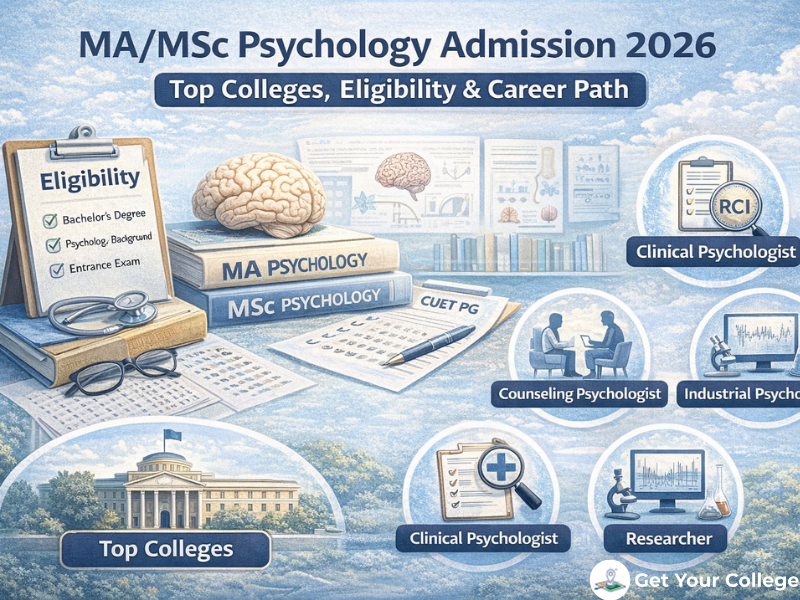
Over the last decade, Psychology has emerged as one of the fastest-growing academic and career fields in India. What was once viewed narrowly as counselling or therapy is now a multi-disciplinary profession spanning mental health, healthcare, corporate settings, education, research, sports, and public policy.
As MA and MSc Psychology admissions 2026 approach, students and parents are asking increasingly serious questions:
What is the difference between MA Psychology and MSc Psychology?
Which are the top colleges for Psychology in India?
Is Psychology a viable long-term career or just a passionate subject?
What entrance exams are required?
What are the real career paths and salary outcomes after a Master’s in Psychology?
This guide is written to help students make informed, realistic, and career-aligned decisions about pursuing an MA or MSc in Psychology in 2026, without confusion, hype, or misinformation.
Several factors have contributed to the rapid growth of Psychology as a field:
Rising awareness of mental health
Increased stress, anxiety, and lifestyle disorders
Corporate focus on employee well-being
Expansion of counselling roles in schools and colleges
Growth of research, behavioural science, and data-driven psychology
Psychology is no longer a niche subject. It is becoming a core societal and professional requirement.
One of the most common confusions is choosing between MA Psychology and MSc Psychology. Both are postgraduate degrees, but their orientation and career focus differ.
MA Psychology generally focuses on:
Theoretical frameworks
Human behaviour and social context
Counselling and applied psychology
Qualitative research
Counselling Psychology
Educational Psychology
Social and Developmental Psychology
Organisational and HR roles
MSc Psychology focuses more on:
Scientific and experimental psychology
Research methodologies
Statistics and quantitative analysis
Biological and cognitive psychology
Clinical Psychology (long-term pathway)
Neuropsychology
Research and academia
Health and experimental psychology
Factor | MA Psychology | MSc Psychology |
|---|---|---|
Orientation | Arts & applied | Science & research |
Focus | Counselling, social | Experimental, clinical |
Research Style | Qualitative | Quantitative |
Suitable Background | Arts / Social Sciences | Science / Psychology |
Career Direction | Counselling, HR, and education | Research, clinical, academia |
Neither degree is superior. The right choice depends on career goals, not degree labels.
Eligibility varies slightly by university, but common criteria are as follows:
Bachelor’s degree in:
Psychology (preferred)
Or related fields (depending on the university)
Minimum 50–60% marks for the General category
Relaxation for reserved categories as per norms
Many top universities do not accept students without a psychology degree at the undergraduate level, especially for MSc programs.
Psychology admissions in India are increasingly entrance-exam driven.
CUET PG has become the most important entrance exam for:
Central universities
Some state universities
Psychological theories
Research methods
Statistics
General psychology concepts
Some universities conduct:
Written tests
Interviews
Practical or aptitude assessments
Private and some state universities offer:
Merit-based admissions
Profile-based selection
The following list is based on academic reputation, faculty strength, research exposure, and career outcomes, not marketing rankings.
University | Program Strength |
|---|---|
Delhi University | MA Applied Psychology |
JNU | MA Psychology |
BHU | MA Psychology |
University of Hyderabad | MSc Psychology |
Central University of Karnataka | MSc Psychology |
University | Known For |
|---|---|
TISS | Applied & social psychology |
Christ University | Counselling & applied psychology |
Amity University | Clinical & counselling focus |
Pune University | Research-oriented psychology |
Jamia Millia Islamia | MA Psychology |
College Type | Approx Fees |
|---|---|
Central Universities | ₹20,000 – ₹50,000 |
State Universities | ₹40,000 – ₹1.5 lakhs |
Private Universities | ₹2 – ₹5 lakhs |
Higher fees do not guarantee better clinical exposure.
Cognitive Psychology
Developmental Psychology
Social Psychology
Abnormal Psychology
Research Methods
Psychological Testing
Counselling Techniques
Psychopathology
Neuropsychology
Behavioural Science
Statistics & SPSS
A psychology degree without practical exposure is professionally weak.
Good programs include:
Mandatory internships
Supervised counselling hours
Fieldwork
Case studies
Psychology offers multiple career tracks, each requiring different levels of education and licensing.
Works in schools, colleges, and clinics
Requires MA/MSc Psychology
Additional certifications recommended
Average Salary: ₹3–6 LPA (initial)
Requires MA/MSc + MPhil or equivalent as per RCI norms
Highly regulated profession
Strong demand but strict licensing
Average Salary: ₹6–12 LPA (experienced)
Works in HR, talent management
Corporate mental health
Behavioural assessment
Average Salary: ₹5–10 LPA
School and institutional counselling
Learning and behavioural assessment
Teaching
PhD and research roles
Policy and social research
Psychology careers offer:
Steady growth, not instant high salaries
Strong long-term relevance
High emotional and social impact
Psychology rewards experience, ethics, and skill depth, not shortcuts.
Course | Best For |
|---|---|
Psychology | Mental health & behaviour |
Social Work | Community development |
HR MBA | Corporate management |
Sociology | Research & policy |
Choosing psychology without career clarity
Ignoring licensing requirements
Avoiding internships
Expecting high salaries immediately
Selecting colleges only by brand name
Check the faculty background
Confirm internship exposure
Verify entrance requirements
Understand long-term career path
Avoid unrealistic placement claims
Psychology admissions require deep academic understanding and ethical career guidance. At Get Your College, students receive experience-driven counselling on college selection, entrance exams, career mapping, and long-term licensing pathways, ensuring they choose psychology not just as a degree, but as a responsible profession with purpose and stability.
Yes—for the right students.
Psychology is ideal for those who:
Are genuinely interested in human behaviour
Are patient and emotionally aware
Are willing to invest time in training
Want meaningful, people-centric careers
Psychology is not a shortcut career.
It is a long-term professional journey.
When pursued with clarity and discipline, an MA or MSc in Psychology can lead to deeply fulfilling and impactful careers in 2026 and beyond.