Choosing the right MBA specialisation has become far more important than choosing the MBA college itself. Over the last decade, the Indian and global job markets have evolved rapidly, and by MBA Admissions 2026, the difference between a well-chosen specialisation and a random one can define your entire career trajectory.
Students often ask:
Which MBA specialisation has the best scope in 2026?
Is an AI MBA just hype or a real career option?
Does Business Analytics still have demand?
Is HR, Marketing, or Finance still relevant?
Which specialisation suits my profile, not toppers on LinkedIn?
This blog is written from the perspective of a senior MBA admissions and career counsellor with over 30 years of experience, with one clear objective:
to help students make practical, future-proof, and profile-aligned specialisation choices, not decisions based on trends, peer pressure, or marketing promises.
Earlier, MBA students chose a specialisation in the second year with minimal thought. That era is over.
In 2026:
Recruiters hire for specific skill sets, not generic MBAs
Roles are increasingly domain-focused
Switching specialisations after an MBA is difficult
Salary growth depends heavily on specialisation relevance
An MBA degree opens the door, but your specialization decides which room you enter.
General Management
Traditional Marketing & HR
Core Finance roles
Data-driven decision making
Technology + management integration
Analytics-backed marketing & finance
AI-supported business processes
This is why newer specialisations like AI and Business Analytics are gaining importance—but not for everyone.
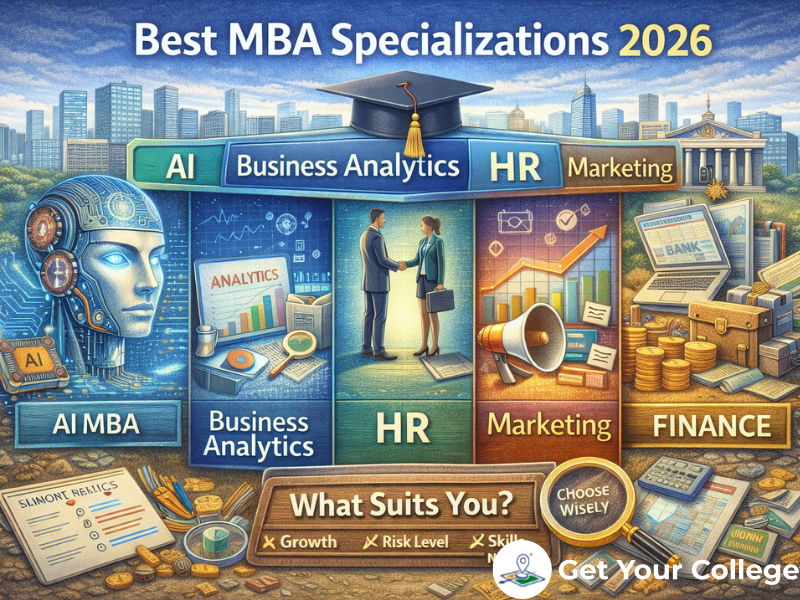
The most relevant MBA specialisations for 2026 include:
MBA in Artificial Intelligence (AI)
MBA in Business Analytics
MBA in Human Resource Management (HR)
MBA in Marketing
MBA in Finance
Each of these has very different skill requirements, career paths, and risk profiles.
MBA in Artificial Intelligence combines:
Core management subjects
AI fundamentals
Machine learning concepts (managerial level)
Automation and digital strategy
It is not a coding-heavy program, but it requires strong technical comfort.
MBA in AI is ideal for students who:
Have an engineering, IT, or analytics background
Are comfortable with technology
Want leadership roles in tech-driven companies
Understand data, systems, and automation
MBA in AI is not suitable for:
Pure commerce or arts students without tech exposure
Those uncomfortable with numbers or systems
Students choose it only for “future scope”
Product Manager (Tech)
AI Strategy Consultant
Digital Transformation Manager
Tech Business Analyst
Automation Program Manager
Experience Level | Average Salary |
|---|---|
Entry-level | ₹8–15 LPA |
Mid-level | ₹18–30 LPA |
Senior roles | ₹35+ LPA |
Reality check:
MBA in AI roles are limited in number but high in value. Only good colleges with industry integration matter.
This specialisation focuses on:
Data-driven decision making
Statistical analysis
Business intelligence tools
Strategy backed by data
Business Analytics is currently one of the most in-demand MBA specialisations, but it is also one of the most misunderstood.
Best suited for students who:
Enjoy working with data
Are strong in mathematics or logical reasoning
Want roles across industries (IT, consulting, finance, FMCG)
Are comfortable with tools and dashboards
Not ideal for:
Students avoiding numbers
Those expecting only managerial work without analytics
Business Analyst
Data Consultant
Strategy Analyst
Analytics Manager
Decision Science Manager
College Tier | Average CTC |
|---|---|
Top Tier | ₹12–20 LPA |
Mid Tier | ₹6–10 LPA |
Important:
Analytics rewards skill depth, not just degree title.
Yes, but HR has changed completely.
Modern HR is about:
Talent strategy
People analytics
Organizational development
Compliance and labour laws
Leadership development
HR is ideal for students who:
Have strong communication skills
Enjoy working with people
Are empathetic yet structured
Want long-term leadership roles
HR is not about:
Only recruitment
Soft roles without pressure
HR Business Partner
Talent Management Specialist
Learning & Development Manager
HR Analytics Manager
Corporate HR Leader
Role Stage | Average Salary |
|---|---|
Entry-level | ₹4–8 LPA |
Mid-level | ₹10–18 LPA |
Leadership | ₹25+ LPA |
HR offers steady growth, not overnight jumps.
Absolutely—but only for students who understand modern marketing.
Marketing today is:
Digital-first
Analytics-driven
Performance-focused
Strongly linked with sales and growth
Marketing suits students who:
Are creative yet analytical
Can handle targets and pressure
Enjoy market-facing roles
Are adaptable and proactive
Marketing is not suitable for:
Students avoiding numbers or performance metrics
Those expecting desk-only roles
Brand Manager
Digital Marketing Manager
Growth Manager
Product Marketing Manager
Sales & Strategy Manager
Level | Average CTC |
|---|---|
Entry | ₹5–10 LPA |
Mid | ₹12–20 LPA |
Senior | ₹30+ LPA |
Marketing rewards performance, not degrees alone.
Yes—but finance is no longer easy or generic.
Finance now demands:
Strong quantitative skills
Certifications (CA, CFA, FRM advantage)
High academic discipline
Finance is best for students who:
Are excellent with numbers
Have strong analytical thinking
Can handle pressure
Prefer structured roles
Finance is not ideal for:
Students are weak in mathematics
Those choosing it only for “high salary”
Financial Analyst
Investment Banker
Corporate Finance Manager
Risk Analyst
CFO-track roles
College Tier | Average CTC |
|---|---|
Top Colleges | ₹15–30 LPA |
Mid Colleges | ₹6–12 LPA |
Finance offers high rewards with high competition.
Specialization | Risk Level | Growth | Skill Demand |
|---|---|---|---|
AI | High | Very High | Very High |
Business Analytics | Medium | High | High |
HR | Low | Stable | Medium |
Marketing | Medium | High | High |
Finance | High | High | Very High |
Assess your academic strengths
Identify your long-term career vision
Match specialization with industry demand
Check college capability for that specialisation
Avoid choosing based on hype or peers
Choosing AI or Analytics without aptitude
Selecting Finance only for salary
Ignoring the college's specialisation strength
Following trends blindly
Not thinking beyond the first job
Choosing an MBA specialisation requires career clarity, aptitude assessment, and realistic market understanding. At Get Your College, students receive experience-driven counselling that aligns specialisation choice with academic background, personality, career goals, and college quality, ensuring they do not regret their MBA decision after graduation. The focus is always on long-term career sustainability, not short-term trends.
There is no single best MBA specialisation.
AI and Analytics offer high growth with high skill demand
HR offers stable and leadership-driven careers
Marketing rewards performance and adaptability
Finance offers elite roles for disciplined candidates
The best specialisation is the one that:
Matches your strengths
Aligns with industry reality
Is supported by the right college
Supports long-term growth
An MBA is a career decision, not a fashion choice.
Choose wisely.