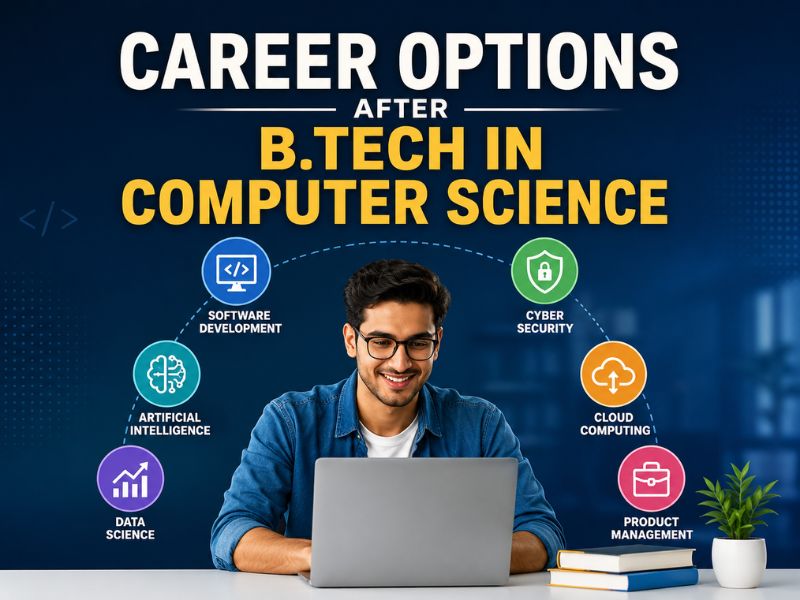
A B.Tech in Computer Science remains one of India's most valuable engineering degrees heading into 2026-2027. With AI, cloud computing, and cybersecurity reshaping the tech industry, CS graduates today have more career paths than ever - from high-paying corporate jobs to higher studies and entrepreneurship. This guide breaks down everything you need to know to plan your next move.
Computer Science is no longer just about "becoming a software developer." A B.Tech CS graduate today can branch into software engineering, data science, artificial intelligence, cybersecurity, cloud architecture, product management, research, government services, or entrepreneurship. The degree builds a foundation in programming, algorithms, data structures, operating systems, databases, and computer networks - a skill set that transfers across nearly every modern industry, from banking and healthcare to e-commerce and manufacturing.
What makes 2026 different from a few years ago is the speed of specialisation. Companies are no longer just hiring "engineers" - they are hiring AI engineers, MLOps specialists, cloud security analysts, and full-stack developers with GenAI tooling experience. This means your career options after B.Tech CS are broader, but success depends increasingly on the specific skills and projects you build during and right after your degree.
Despite predictions that AI would shrink entry-level tech hiring, demand for skilled CS graduates remains strong. India's IT exports crossed $250 billion in 2026, with CSE graduates driving much of this growth, and Generative AI adoption by Indian companies grew threefold between 2025 and 2026, creating urgent demand for ML and AI engineers. Globally, AI labs and Indian GenAI startups are actively hiring CS talent, and core software roles remain the backbone of every digital business.
The "future-proofing" of a CS degree comes from its flexibility. Engineers who once wrote only backend code are now expected to understand AI model integration, cloud-native architecture, and security-by-design — and B.Tech CS programs increasingly weave these into the core curriculum rather than treating them as electives.
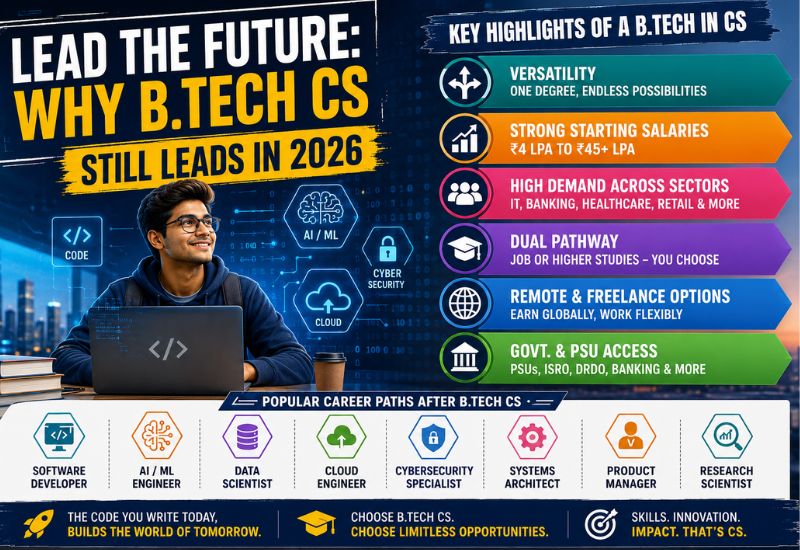
Versatility: One degree opens doors to software development, AI/ML, data science, cybersecurity, cloud computing, product management, and research.
Strong starting salaries: Entry-level packages typically range from ₹4 LPA to ₹45+ LPA, depending on the company tier and specialisation.
High demand across sectors: Banking, healthcare, retail, logistics, and government bodies all hire CS engineers, not just IT companies.
Dual pathway: You can go straight into a job or pursue higher studies (M.Tech, MS, MBA) — and many professionals do both, sequentially.
Remote and freelance options: Global freelancing platforms allow skilled developers to earn well beyond typical Indian salary bands.
Govt. and PSU access: GATE-qualified CS graduates can enter PSUs, ISRO, DRDO, and banking IT officer roles with strong job security.
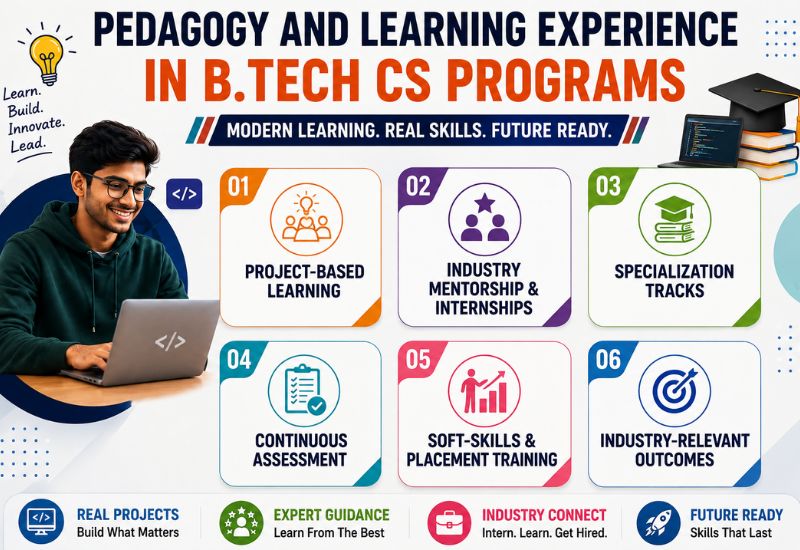
Modern B.Tech CS programs have evolved well beyond chalk-and-board theory. Most reputed institutes in 2026 now combine:
Project-based learning: Capstone projects, hackathons, and industry-sponsored problem statements replace pure rote learning.
Industry mentorship and internships: Programs increasingly tie up with tech companies for structured internships (similar to BITS Pilani's Practice School model), giving students real exposure to production-grade systems.
Specialisation tracks: Many colleges now offer B.Tech CS with built-in specialisations — AI & Machine Learning, Data Science, Cybersecurity & Blockchain, or IoT — allowing students to graduate job-ready in a niche.
Continuous assessment: A mix of coding contests, lab evaluations, peer-reviewed projects, and viva-based assessments rather than only semester-end exams.
Soft-skills and placement training: Communication, teamwork, and interview preparation are built into the final years to improve placement outcomes.
This hands-on pedagogy matters because recruiters in 2026 consistently report that project portfolios and demonstrated skills matter more than college brand name alone, particularly for product-based companies and startups.
Salary outcomes vary widely based on company type, specialisation, and individual skill level. Here's a realistic breakdown for 2026:
Company/Sector Type | Average Package (LPA) |
IT services (TCS, Infosys, Wipro) | ₹3.5 – 6.5 |
Funded startups | ₹8 – 15 |
Product-based companies | ₹15 – 25 |
FAANG/global tech (Google, Amazon, Microsoft) | ₹25 – 45 |
Government/PSU (via GATE) | ₹7 – 15 + pension benefits |
The salary difference between IT services and FAANG-level companies comes down largely to individual preparation rather than the college attended — two graduates from the same campus can see a tenfold difference based on their data structures and algorithms skills and project portfolio.
Specialization | Typical Fresher Salary (LPA) |
AI/ML Engineering | ₹12 – 30 |
Data Science | ₹15 – 35 |
Cloud Computing | ₹10 – 22 |
Cybersecurity | ₹6 – 20 |
DevOps Engineering | ₹8 – 18 |
Web3/Blockchain | ₹10 – 25 |
Cloud computing, cybersecurity, and full-stack development are considered the three hottest in-demand skills for engineering graduates in 2026.
It's worth noting that compensation isn't limited to salaried roles. Skilled developers can also earn well through international freelance platforms like Upwork or Toptal. At the same time, startup roles often come with equity or performance bonuses that boost overall compensation even when the base pay starts lower.
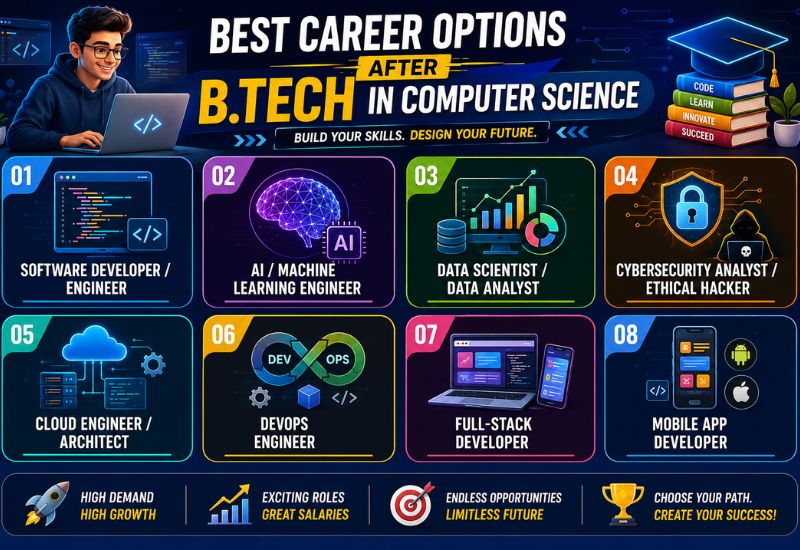
1. Software Developer / Engineer
The most common path — designing, building, and maintaining applications using languages like Java, Python, C++, or JavaScript. This role remains the foundation for almost every other specialisation in tech.
2. AI/Machine Learning Engineer
One of the fastest-growing roles in 2026, involving building and training models using tools like TensorFlow and PyTorch. Global AI firms including OpenAI, Google DeepMind, Anthropic, and Indian players like Krutrim and Sarvam AI are actively hiring AI engineers in India, with packages reaching ₹25–60 LPA at top global firms.
3. Data Scientist / Data Analyst
Working with large datasets to extract insights using Python, R, SQL, and machine learning techniques. High demand exists in fintech, e-commerce, and healthcare analytics.
4. Cybersecurity Analyst / Ethical Hacker
Protecting systems from breaches using network security, ethical hacking, and incident response skills. There are roughly 3.5 million unfilled cybersecurity jobs globally, and India's demand is growing fast, with CEH and OSCP certified freshers earning between ₹6 and ₹20 LPA.
5. Cloud Engineer/Architect
Managing and migrating systems to AWS, Azure, or Google Cloud Platform. Nearly every company is moving to cloud infrastructure, making this one of the most stable high-growth roles.
6. DevOps Engineer
Bridging development and operations using CI/CD pipelines, Docker, and Kubernetes to streamline software delivery.
7. Full-Stack Developer
Handling both front-end and back-end development — a versatile, consistently in-demand role across startups and enterprises alike.
8. Mobile App Developer
Building applications for Android/iOS, with strong demand from consumer apps, fintech, and e-commerce companies.
9. Blockchain/Web3 Developer
A smaller but high-paying niche involving smart contracts, DeFi platforms, and Solidity development.
10. Product Manager (post-experience or post-MBA)
Bridging the gap between business and engineering teams — typically pursued after 2-3 years of technical experience or an MBA.
11. Technical Writer / Developer Advocate
A growing niche role for engineers with strong communication skills, focused on documentation, tutorials, and community engagement for developer tools.
12. Entrepreneurship/Startup Founder
Many CS graduates use their technical skills to build their own products rather than joining existing companies — a path supported by India's growing startup ecosystem.
If you'd rather deepen your expertise before entering the workforce (or alongside it), here are the major higher-education routes:
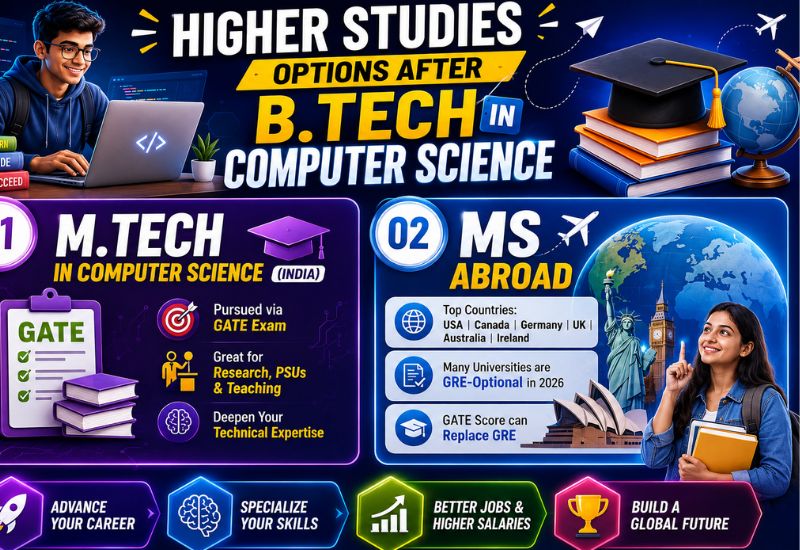
M.Tech in Computer Science (India)
Pursued via the GATE exam, M.Tech is ideal for those targeting research roles, PSU jobs, or teaching positions. The GATE CS syllabus covers algorithms, data structures, operating systems, computer networks, databases, compiler design, digital logic, and theory of computation — essentially testing your entire B. Tech curriculum in a single three-hour exam, with negative marking for incorrect answers. Serious preparation typically takes six to eight months.
MS Abroad
A popular choice for those seeking global exposure. The top countries for an MS after B.Tech are the USA, Canada, Germany, the UK, Australia, and Ireland, valued for their strong programs and available funding options. For 2026 intakes, many non-US destinations have moved away from mandatory GRE requirements — Germany's public universities, Ireland's UCD and Trinity, Australia's Monash, and Canada's Regina and Concordia are largely GRE-optional, while some competitive Canadian programs like UBC's MS in CS still expect strong GRE scores.
Interestingly, your GATE score can sometimes substitute for the GRE. Several top-ranking universities in Germany and Singapore accept GATE scores in place of GRE, and a GATE score above the 90th percentile can even open up funded research and scholarship opportunities abroad.
A large number of B.Tech CS graduates pursue an MBA — particularly an MBA in IT — because it widens career opportunities into management roles across virtually any sector. An MBA from a top IIM can lead to significantly higher post-MBA compensation, especially in consulting, product management, or tech leadership tracks.
M.Phil / PhD in Computer Science
For those drawn to research and academia, this path focuses on the theoretical side of computer science and can lead to roles as university professors or research scientists at organisations like ISRO and DRDO.
Specialised Certifications and Short-Term Courses
Rather than (or alongside) a full postgraduate degree, many graduates opt for focused certifications:
Cloud: AWS Solutions Architect, Microsoft Azure certifications
Cybersecurity: CEH, CompTIA Security+, OSCP
Data: Google Data Analytics Certificate, IBM Data Analyst Certificate
Networking: Cisco CCNA
Cybersecurity and Cyber Law is a particularly underserved niche in India relative to demand, making it a strong area to specialise in through dedicated programs, many of which are now offered online by prestigious universities.
Completing an M.Tech, MS, or MBA after B.Tech CS generally translates into:
Higher entry salaries compared to direct-from-undergrad hires — postgraduate AI/ML and data science specialists in India often command ₹15-35+ LPA, and significantly more at global firms.
Access to research and R&D roles at organisations like ISRO, DRDO, and top global tech labs, which typically require at least a master's degree.
Eligibility for international roles — an MS abroad often comes with better visa and stay-back options in countries like Canada, Germany, and Australia, opening doors to global salary bands.
Leadership fast-tracking — an MBA, especially from a top-tier B-school, can fast-track you into product management, consulting, or general management roles that are otherwise harder to access directly from a technical background.
Academic careers — a PhD or M.Phil opens the door to professorships and funded research positions, which are not accessible through industry experience alone.
The trade-off is time and cost: 1-2 additional years of study (plus tuition, in the case of MS/MBA abroad) versus jumping straight into a paying job. For many, the smarter move is gaining 1-3 years of work experience first, then pursuing higher studies — both because it strengthens applications and because some scholarships/programs explicitly favour candidates with work experience.
If you choose to enter the workforce directly, here's how the job landscape typically breaks down:
By company type:
IT services giants (TCS, Infosys, Wipro, Cognizant): High-volume hiring, moderate starting salaries (₹3.5-6.5 LPA), strong as a launchpad role.
Product-based companies (Flipkart, Zoho, Freshworks): Better pay (₹10-25 LPA), more ownership over what you build.
Global tech/FAANG (Google, Amazon, Microsoft, Adobe): Highest packages (₹25-45 LPA), but require strong DSA and system design preparation.
Startups: Variable base pay but attractive equity, faster growth, and broader role exposure.
Government/PSU: Roles via GATE or direct recruitment at ISRO, DRDO, NIC, CDAC, and banking IT officer positions — offering strong job security and pension benefits, with packages typically between ₹7-15 LPA.
Path to top-tier offers: Getting into a FAANG-level company after B.Tech CSE generally requires strong data structures and algorithms practice (often 300+ problems on platforms like LeetCode), solid system design fundamentals, deep knowledge of core CS subjects like operating systems, DBMS, and computer networks, plus two to three strong real-world projects on GitHub. Most successful candidates start this preparation from the first year and aim for a product-company internship by their third year.
You don't have to choose just one path — and increasingly, professionals are combining both:
Work first, study later: Many engineers work for 1-3 years to build savings, gain practical experience, and strengthen their resume before pursuing an MS abroad or an MBA. This also helps with scholarship eligibility, since several programs favour applicants with demonstrated work experience.
Study while working: Online and part-time M.Tech, MBA, or certification programs allow working professionals to upskill without quitting their job — a particularly popular route for cloud, AI, and cybersecurity certifications.
Sponsored higher studies: Some companies sponsor employees for relevant master's programs or certifications in exchange for a service commitment, especially in PSU and large-MNC settings.
Immediate higher studies, then return to industry: Fresh graduates going straight into an M.Tech or MS often re-enter the job market at a more senior or specialised level, commanding higher starting salaries than direct-from-B. TechTech hires.
The "jobs plus higher studies" approach essentially lets you de-risk your career: you gain income and real-world skills early, while keeping the option open to specialise or move abroad later with a stronger profile.
Frequently Asked Questions (FAQs) About Career Options After B.Tech in Computer Science
Q1. What is the average starting salary after B.Tech in Computer Science in India in 2026? A1. For 2026, freshers from service-based companies like TCS or Infosys typically start around ₹4 LPA, while product-based companies like Google, Amazon, and Adobe offer between ₹12 LPA and ₹30 LPA for roles such as software development engineer or data analyst.
Q2. Is B.Tech CS still a good career choice given AI advancements? A2. Yes — AI is expected to enhance rather than replace CSE roles; while it may automate routine coding tasks, engineers are still needed to design, train, and manage AI systems, and AI is even creating new roles in automation, ethical AI, and applied research.
Q3. Should I do an M.Tech or go for a job directly after B.Tech CS? A3. B.Tech CSE is one of the few degrees that lets you secure a high-paying job immediately without needing a higher degree, while higher studies can open the door to even better packages — so the right choice depends on your personal career goals rather than one option being universally better.
Q4. Is GATE necessary for higher studies after B.Tech CS? A4. GATE is necessary only if you want to pursue an M.Tech in India or apply for certain PSU jobs. If you're aiming for an MS abroad, most non-US destinations have moved toward GRE-optional or no-GRE admissions, making GATE or GRE not always mandatory depending on the country and university.
Q5. Can I study abroad using my GATE score instead of the GRE? A5. Yes — several universities in Singapore, Germany, and the UK accept GATE scores as an alternative to the GRE for engineering and technology programs, though U.S. universities generally still prefer GRE scores for graduate admissions.
Q6. Which specialisation pays the highest salary after B.Tech CS in 2026? A6. Based on current market data, Data Science (₹15-35 LPA) and AI/ML Engineering (₹12-30 LPA) offer the highest fresher salary ranges, with global AI firms paying significantly more for specialised roles.
Q7. Are government jobs a good option after B.Tech CS? A7. Yes. B. Tech CS graduates can apply for UPSC, PSU jobs through GATE, SSC, banking exams, and technical roles in railways and defence sectors, offering strong stability and benefits alongside competitive pay.
Q8. Is an MBA worth it after B.Tech in Computer Science? A8. It can be highly rewarding — pursuing an MBA after B.Tech CS, especially from a top IIM, can lead to salary packages in the crores for those who move into senior management or consulting roles.
Q9. What skills should I focus on during ?. Tech CS to get a high-paying job? A9. Cloud computing, cybersecurity, and full-stack development are considered the three hottest skills for engineering graduates in 2026, alongside strong fundamentals in data structures, algorithms, and at least one area of specialisation, like AI/ML or data science.
Q10. Can I freelance or work remotely after B.Tech CS instead of taking a full-time job? A10. Yes. Proficient developers can earn between ₹1-3 lakhs per month through international freelance portals like Upwork or Toptal, making freelancing a viable alternative or supplement to traditional employment.
Conclusion
A B.Tech in Computer Science in 2026-2027 offers more flexibility than ever — whether you want to step straight into a high-paying tech job, specialise through higher studies, head abroad for an MS, or build your own startup. The degree itself opens the door, but your specific skills, projects, and chosen specialisation will determine how far that door leads. Whatever path you choose, staying current with emerging technologies like AI, cloud, and cybersecurity will be key to standing out in an increasingly competitive — and increasingly rewarding — tech job market.