

Get Your College logo
  1. Home
  2. BTech in Cyber Security 2026: Course Details, Eligibility, Fees & Scope
BTech in Cyber Security Course Details 2026

BTech in Cyber Security 2026: Course Details, Eligibility, Fees & Scope

May 27, 2026
19 min read

As the world becomes increasingly digital, cyber threats are growing faster than ever. From banking systems and government networks to social media platforms and multinational companies, cybersecurity has become one of the most critical areas in modern technology.

In 2026, cyber attacks, data breaches, ransomware, ethical hacking, AI-based threats, and digital fraud are major global concerns. Because of this, organisations across the world are investing heavily in cybersecurity professionals who can protect systems, networks, and sensitive information.

B.Tech. in Cyber Security is one of the fastest-growing engineering programs today. It combines computer science, networking, ethical hacking, data protection, cloud security, and artificial intelligence to prepare students for high-demand technology careers.

This complete guide covers everything students need to know about B.Tech. in Cyber Security, including eligibility, fees, admission process, syllabus, top colleges, placements, salary, career scope, future opportunities, latest trends, and expert career tips.

What is BTech in Cyber Security

B.Tech.h in Cyber Security is a 4-year undergraduate engineering program focused on protecting computer systems, digital networks, applications, and data from cyber threats and unauthorised access.

The course teaches students how to identify vulnerabilities, prevent hacking attempts, secure cloud systems, manage digital risks, and build secure IT infrastructure.
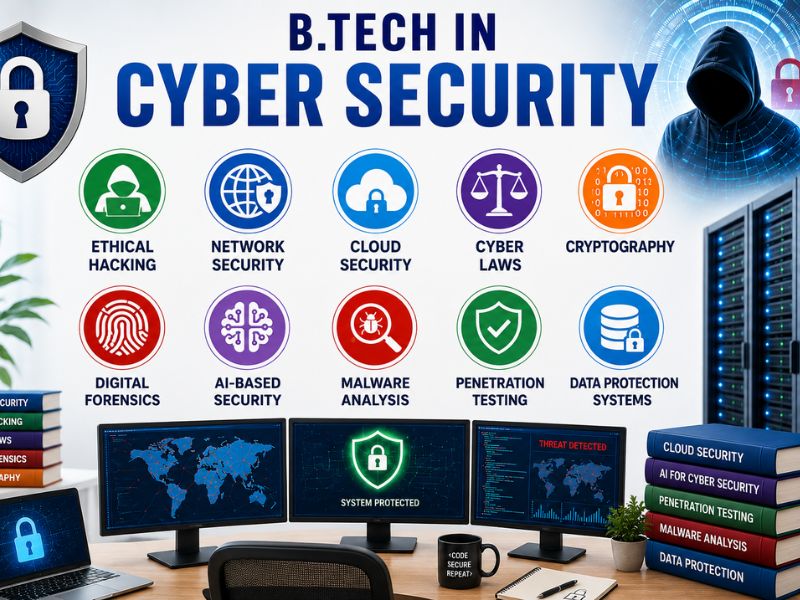
Ethical Hacking

Students learn how ethical hackers identify vulnerabilities and security weaknesses in computer systems and networks. Ethical hacking helps organisations strengthen their digital security by testing systems against cyber threats in a legal and controlled manner.

Network Security

Network security focuses on protecting computer networks, servers, and communication systems from unauthorised access, cyberattacks, malware, and data breaches. Students learn firewall management, intrusion detection, and secure networking techniques.

Cloud Security

Cloud security teaches students how to secure cloud-based applications, online data storage, and digital business systems. As companies increasingly use cloud technologies, cloud security has become one of the most important cybersecurity domains.

Cyber Laws

Students learn about cyber laws, digital regulations, data privacy policies, intellectual property rights, and legal frameworks related to online activities and cybercrime management.

Cryptography

Cryptography focuses on encryption techniques used to secure sensitive digital information and online communication. Students understand how encryption protects confidential data from hackers and unauthorised access.

Digital Forensics

Digital forensics involves investigating cybercrimes, recovering digital evidence, analysing hacked systems, and tracking cybercriminal activities. Students learn forensic tools and cyber investigation techniques used in real-world security operations.

AI-Based Security Systems

Artificial Intelligence is increasingly used in cybersecurity for threat detection, automated monitoring, predictive analysis, and intelligent cyber defence systems. Students learn how AI improves modern security infrastructure.

Malware Analysis

Malware analysis teaches students how viruses, ransomware, spyware, and malicious software operate. Students learn techniques to identify, analyse, and prevent different types of cyber threats.

Penetration Testing

Penetration testing focuses on simulated cyberattacks used to evaluate system security. Students learn how security professionals test applications and networks to identify vulnerabilities before real hackers exploit them.

Data Protection Systems

Students learn how organisations secure sensitive customer information, financial records, and confidential business data through advanced data protection technologies, privacy frameworks, and security management systems.

Cybersecurity education helps students develop practical technical skills, analytical thinking, and advanced digital security knowledge required to protect modern organisations from evolving cyber threats. With increasing cybercrime and digital transformation worldwide, cybersecurity remains one of the fastest-growing and most future-focused technology career fields.

Key Insights 

Cybercrime = Rapidly Increasing Globally

Cybercrime is growing at an unprecedented rate as businesses, governments, and individuals increasingly depend on digital systems and online platforms. From ransomware attacks to large-scale data breaches, organisations across industries are investing heavily in cybersecurity to protect sensitive information and digital infrastructure.

The rising frequency of cyberattacks is creating a strong long-term demand for skilled cybersecurity professionals worldwide.

Digital Economy = Rising Security Demand

The expansion of the digital economy, cloud computing, e-commerce, fintech, and online services has significantly increased the need for advanced cybersecurity solutions. Companies now require strong digital protection systems to secure customer data, online transactions, and business operations.

As digital transformation accelerates globally, cybersecurity is becoming a critical business priority rather than just an IT function.

AI + Cybersecurity = Future-Focused Field

Artificial Intelligence is rapidly transforming modern cybersecurity systems through intelligent threat detection, predictive analytics, automated monitoring, and real-time security response mechanisms. AI-driven cyber defence systems are helping organisations identify and prevent cyber threats more efficiently.

Professionals with knowledge of both AI and cybersecurity are expected to have excellent future career opportunities in advanced security technologies.

Government + Private Hiring = Expanding Rapidly.

Both government organisations and private companies are aggressively hiring cybersecurity professionals to strengthen digital protection systems and reduce cyber risks. Industries such as banking, healthcare, defence, e-commerce, IT services, and fintech are continuously increasing cybersecurity investments.

Government sectors are also expanding cyber defence infrastructure and digital security programs, creating strong job opportunities for skilled cybersecurity graduates.

Cybersecurity has become one of the fastest-growing and most future-oriented technology career fields due to rising cybercrime, digital business expansion, AI integration, and increasing global demand for digital protection systems.

Why Choose BTech in Cyber Security?

BTech in Cyber Security has emerged as one of the most in-demand engineering programs due to the rapid growth of digital technologies, online businesses, cloud computing, and cyber threats worldwide. Today, cybersecurity professionals are essential across industries such as banking, healthcare, e-commerce, defence IT services, fintech, and government organisations.

As companies continue shifting toward digital operations, the need for skilled cybersecurity experts is increasing rapidly across global markets.


Major Benefits

Extremely High Industry Demand

Cyberattacks, data breaches, ransomware incidents, and online fraud are increasing globally. Organisations constantly require skilled cybersecurity professionals to protect networks, systems, and sensitive digital information from security threats.

Strong Salary Potential

Cybersecurity is considered one of the highest-paying technology career domains. Skilled professionals in ethical hacking, cloud security, penetration testing, and digital forensics often receive attractive salary packages and rapid career growth opportunities.

Global Career Opportunities

Cybersecurity professionals are in demand across multiple countries, including the USA, Canada, Germany, Australia, the  UAE, and Singapore. Since cyber threats affect organisations worldwide, skilled professionals can explore international career opportunities in both private and government sectors.

Future-Proof Technology Field

As digital transformation continues expanding, cybersecurity will remain one of the most future-focused technology fields. Businesses, governments, and digital platforms will continue investing heavily in cyber defence systems and data protection technologies.

Remote Job Opportunities

Many cybersecurity roles support remote and hybrid working models because security monitoring, threat analysis, and network protection can often be managed digitally. This creates flexible work opportunities for professionals across global companies.

High-Growth IT Sector Relevance

Cybersecurity plays a critical role in modern IT infrastructure, cloud computing, software development, artificial intelligence, and digital business systems. The field continues growing alongside the expansion of the global technology industry.

Strong Startup Ecosystem Demand

Startups, fintech companies, SaaS businesses, and digital platforms increasingly require cybersecurity professionals to secure applications, user data, and online business operations from cyber threats and compliance risks.

Key Insights

Cyber Threats = Continuous Demand

The increasing frequency of cyberattacks and online security breaches ensures long-term demand for skilled cybersecurity professionals across industries worldwide.


Digital Transformation = More Security Jobs

As businesses adopt cloud technologies, AI systems, digital payments, and online services, the demand for cybersecurity experts continues to expand rapidly.


Remote Work = Growing Opportunities

The rise of remote work environments and cloud-based systems has created additional security challenges, increasing the need for professionals who can manage secure digital operations remotely.


Data Protection = Global Priority

Data privacy, digital security regulations, and information protection have become major global priorities for businesses and governments, making cybersecurity one of the most important technology sectors.

B.Tech. in Cyber Security offers strong career opportunities, excellent salary potential, global demand, and long-term industry relevance. With cyber threats increasing and digital transformation accelerating worldwide, cybersecurity remains one of the most future-proof and high-growth engineering fields in 2026 and beyond.

BB.Tech.Cybersecurity is ideal for students interested in technology, ethical hacking, AI, and digital security systems.

Eligibility Criteria for B.Tech. in Cyber Security

Students interested in pursuing BTech in Cyber Security must fulfil specific academic and admission requirements set by engineering colleges and universities. The eligibility criteria are designed to ensure students have a strong foundation in science, mathematics, and analytical thinking required for technology-based education.


Cybersecurity programs focus heavily on problem-solving, technical skills, and digital systems, making academic preparation in PCM subjects highly important.

Basic Requirements

10+2 with Physics, Chemistry, and Mathematics

Students must complete Class 12 from a re-recognised board with Physics, Chemistry, and Mathematics (PCM) as core subjects. PCM provides the technical and mathematical foundation required for engineering and cybersecurity studies.

Minimum 50%–75% Marks

Most colleges require students to secure a minimum percentage in Class 12 examinations. Eligibility criteria may vary depending on the institution, entrance exam requirements, and category reservations.

Top engineering institutes generally require higher academic scores due to strong competition for admission.

Entrance Exams

JEE Main

JEE Main is one of the most widely accepted national-level engineering entrance examinations for admission into B.Tech. programs, including Cyber Security specialisation.

State Engineering Exams

Many state-level engineering colleges conduct separate entrance examinations for admission into engineering and technology programs.

University Entrance Tests

Private universities and autonomous institutions may conduct their own entrance tests or admission processes for B.Tech. Cyber Security programs.

Skills Required

Logical Thinking

Cybersecurity professionals constantly analyse digital threats, security vulnerabilities, and system behaviour. Strong logical thinking helps students solve technical problems effectively.

Problem-Solving Ability

Students should possess strong problem-solving skills to identify cyber threats, troubleshoot security issues, and create effective protection strategies for digital systems.

Technical Interest

A strong interest in technology, computers, networking, and digital systems helps students perform better in cybersecurity education and practical learning environments.

Analytical Mindset

Cybersecurity requires continuous analysis of data, network activity, system vulnerabilities, and cyberattack patterns. Analytical thinking is one of the most valuable skills in this field.

Curiosity About Technology

Students who are naturally curious about how digital systems, software, networks, and online platforms work often perform well in cybersecurity careers.

Basic Coding Interest

Although advanced programming expertise is not always required at the beginning, interest in coding and software understanding helps students learn ethical hacking, scripting, automation, and security testing more effectively.

Key Insight

Cybersecurity is a highly practical and technology-driven field where analytical skills, logical thinking, and technical curiosity are often more important than theoretical learning alone.

OBottommLine

B.Tech. in Cyber Security is an excellent option for students interested in technology, digital protection systems, ethical hacking, and advanced IT security. With strong academic preparation and technical interest, students can build successful careers in one of the fastest-growing technology sectors globally.

Eligibility Criteria for B.Tech. in Cyber Security

Students who want to pursue B.Tech. in Cyber Security must fulfil certain academic and entrance-based eligibility requirements. The course is designed for students interested in technology, digital security, ethical hacking, networking, and advanced IT systems.

Most engineering colleges and universities require students to have a strong foundation in science and mathematics before entering the cybersecurity field.

Basic Requirements

10+2 with Physics, Chemistry, and Mathematics

Students must complete Class 12 from a re-recognised board with Physics, Chemistry, and Mathematics (PCM) as core subjects. These subjects provide the technical and analytical foundation needed for engineering and cybersecurity education.

Minimum 50%–75% Marks

Most colleges require students to secure a minimum percentage in Class 12 examinations. Eligibility criteria may vary depending on the college, category reservation, and admission competition.

Top engineering institutes generally require higher academic scores due to strong competition and limited seat availability.

Entrance Exams

JEE Main

JEE Main is one of the most commonly accepted engineering entrance exams for admission into BTech Cyber Security and related computer science programs across India.

State Engineering Exams

Several state governments conduct their own engineering entrance examinations and counselling processes for admission into government and private engineering colleges.

University Entrance Tests

Many private universities and autonomous institutions conduct university-level entrance tests or direct admission processes for B.Tech. in Cyber Security programs.

Skills Required

Logical Thinking

Cybersecurity professionals must analyse complex digital threats, security vulnerabilities, and system behaviour. Strong logical thinking helps students solve technical problems effectively.

Problem-Solving Ability

Students should have strong problem-solving skills to identify cyber risks, troubleshoot security issues, and create effective protection systems against cyberattacks.

Technical Interest

A genuine interest in computers, networking, software systems, and digital technologies helps students perform better in cybersecurity education and practical training.

Analytical Mindset

Cybersecurity involves continuous monitoring, data analysis, vulnerability assessment, and security evaluation. Analytical thinking is one of the most important skills in this field.

Curiosity About Technology

Students who are curious about how digital systems, applications, networks, and online platforms function often adapt quickly to cyber security concepts and advanced technologies.

Basic Coding Interest

Although students are not always required to be expert programmers initially, an interest in coding and software logic helps in learning ethical hacking, scripting, penetration testing, and security automation.

Key Insight

Cybersecurity is a highly practical and future-focused technology field where analytical thinking, technical curiosity, and continuous learning play a major role in long-term success.

Bottom Line

BB.Tech.Cybersecurity is an excellent career option for students interested in technology, ethical hacking, digital protection systems, and advanced IT security. With strong academic preparation and technical skills, students can build successful careers in one of the fastest-growing technology sectors globally.

Admission Process for BTech in Cyber Security (Step-by-Step)

The admission process for BTech in Cyber Security is designed to help students secure admission into engineering colleges based on academic performance and entrance exam scores. Most universities and engineering institutes follow a merit-based admission system combined with counselling and document verification procedures.

Students interested in Cyber Security engineering should carefully follow each admission step to improve their chances of getting admission into reputed colleges and universities.

Complete 12th with PCM

Students must complete Class 12 with Physics, Chemistry, and Mathematics (PCM) from a recognised board. Science stream education provides the technical, logical, and mathematical foundation required for engineering and cybersecurity studies.

Strong academic performance in PCM subjects can improve admission opportunities in top engineering colleges.

Appear for Entrance Exams

Admission into BTech Cyber Security programs is generally based on engineering entrance examinations conducted at national, state, or university levels.

JEE Main

JEE Main is one of the most widely accepted engineering entrance examinations for admission into B.Tech. programs across India, including Cyber Security specialisation.

State Counseling

Many states conduct centralised engineering counselling processes where students receive college allotments based on entrance exam rank, merit scores, and seat availability.

University-Level Exams

Private universities and autonomous institutions may conduct their own entrance tests or direct admission evaluation processes for B.Tech. in Cyber Security admissions.

Government Colleges

Government colleges offering BTech in Cyber Security are generally known for affordable fee structures and strong academic value. The total course fees in most government institutions usually range between ₹80,000 and ₹4 Lakhs for the complete program. These colleges are considered a good option for students looking for quality technical education with better return on investment and lower financial burden.

Private Colleges

Private universities generally charge higher fees for BTech Cyber Security programs because they invest heavily in modern infrastructure, advanced cyber labs, cloud security platforms, AI-based learning systems, and industry-oriented training. The overall fees in private colleges usually range between ₹5 Lakhs and ₹15 Lakhs, depending on facilities, placements, and university reputation.

Private Colleges Dominate Cyber Security Education

Many private institutions are rapidly expanding Cyber Security programs due to increasing global demand for security professionals. These universities often provide up-to-date curriculum, practical learning environments, certifications, and exposure to modern cyber technologies that closely align ith industry requirements.

Advanced Labs Increase Infrastructure Costs

Cybersecurity education requires specialised practical infrastructure such as ethical hacking labs, digital forensics systems, network security environments, malware analysis tools, and cloud security platforms. Maintaining these advanced facilities increases the operational and infrastructure costs for colleges.

Scholarships Available in Some Universities

Several universities and engineering institutions provide scholarships and financial assistance based on academic performance, entrance exam scores, merit rankings, sports achievements, or financial background. These scholarship opportunities help students reduce the overall cost of pursuing technical education in Cyber Security.

Computer Networks

Computer Networks is one of the foundational subjects in Cyber Security that helps students understand how computers communicate and exchange data over digital networks. Students learn about network architecture, protocols, routers, switches, and secure communication systems used in modern IT infrastructure.

Ethical Hacking

Ethical Hacking teaches students how security professionals identify vulnerabilities and weaknesses in systems before cybercriminals can exploit them. The subject focuses on penetration testing, security assessment, and legal hacking techniques used to strengthen digital security.

Cyber Laws

Cyber Laws help students understand the legal framework related to cybercrime, data privacy, digital fraud, online security, and information protection. This subject provides knowledge about legal responsibilities and cyber regulations in the digital world.

Cryptography

Cryptography focuses on encryption and secure communication techniques used to protect confidential digital information. Students learn how encryption algorithms secure online transactions, passwords, and sensitive business data from unauthorised access.

Information Security

Information Security teaches students how organisations protect digital assets, confidential information, and IT infrastructure from cyber threats. The subject covers security policies, risk management, access control, and protection systems.

Artificial Intelligence

Artificial Intelligence is becoming increasingly important in Cyber Security for automated threat detection, predictive analysis, and intelligent monitoring systems. Students learn how AI technologies improve modern cyber defence mechanisms.

Cloud Security

Cloud Security focuses on securing cloud-based applications, online storage systems, and digital business platforms. Students understand cloud vulnerabilities, access management, and protection strategies used in cloud computing environments.

Data Structures

Data structures help students understand how data is organised, stored, and managed within computer systems. This subject strengthens programming logic and improves problem-solving skills required in cybersecurity operations.

Operating Systems

Operating Systems provide knowledge about how computer systems function internally. Students learn system management, file systems, memory handling, process management, and operating system security concepts.

Digital Forensics

Digital Forensics teaches students how cybercrime investigations are conducted using digital evidence. Students learn data recovery, cyber investigation methods, forensic tools, and techniques used to analyse hacked systems and security incidents.

Security Labs

Security labs provide practical exposure where students work on real-time cybersecurity tools, network monitoring systems, ethical hacking platforms, and security testing environments to develop hands-on technical skills.

Penetration Testing

Penetration testing helps students understand how cybersecurity professionals simulate attacks to identify vulnerabilities in applications, servers, and networks before actual hackers exploit them.

Live Projects

Live projects allow students to work on practical industry-based assignments related to cybersecurity, cloud protection, vulnerability analysis, and digital security management. These projects improve real-world technical understanding.

Internships

Internships provide students with practical industry exposure and professional experience in cybersecurity companies, IT firms, and technology organisations. Internships help improve technical skills and placement opportunities.

Cyber Simulations

Cyber simulations create virtual attack-and-defence environments where students practice handling cyber threats, security breaches, malware attacks, and network vulnerabilities in controlled digital systems.

Top Specialisations in Cyber Security

Ethical Hacking

Ethical Hacking is one of the most popular Cyber Security specialisations where students learn how to identify vulnerabilities and security weaknesses in digital systems legally and ethically. Professionals in this field help organisations strengthen their security infrastructure by performing controlled security testing.

Cloud Security

Cloud Security focuses on protecting cloud-based applications, online storage systems, and digital business platforms from cyber threats. As businesses rapidly shift toward cloud computing, demand for cloud security professionals is increasing significantly.

Network Security

Network Security teaches students how to secure computer networks, servers, and communication systems from unauthorised access, malware attacks, and cyber intrusions. This specialisation remains highly important for IT companies and enterprise infrastructure.

AI Security

AI Security combines Artificial Intelligence with Cyber Security to improve automated threat detection, predictive analysis, and intelligent security monitoring systems. This emerging field is becoming highly valuable in modern cyber defence strategies.

Blockchain Security

Blockchain Security focuses on securing blockchain networks, cryptocurrency systems, and decentralised digital platforms. Students learn how blockchain technology enhances secure digital transactions and protects sensitive information.

Digital Forensics

Digital Forensics involves cybercrime investigation, digital evidence collection, and security breach analysis. Students learn forensic tools and investigation techniques used by law enforcement agencies, security firms, and cyber investigation teams.

OT Security

IoT Security focuses on protecting Internet of Things devices such as smart appliances, industrial sensors, healthcare systems, and connected digital devices from cyberattacks and unauthorised access.

Malware Analysis

Malware Analysis teaches students how viruses, ransomware, spyware, and malicious software function. Students learn techniques to detect, analyse, and prevent malware-based cyber threats in digital environments.

AI-Based Cyber Defense

AI-based cyber defence systems use machine learning and intelligent automation to identify suspicious activities, detect cyber threats, and improve real-time security response mechanisms. This technology is becoming a major trend in advanced cybersecurity.

Zero-Trust Security

Zero-trust security is a modern security approach where no user or system is automatically trusted. Every access request is continuously verified to improve digital protection and reduce security risks in organisations.

Quantum-Safe Encryption

Quantum-safe encryption focuses on advanced encryption technologies designed to protect digital information from future quantum computing threats. This field is expected to become highly important in next-generation cybersecurity systems.

Cloud-Native Security

Cloud-native security helps organisations secure applications and services built directly for cloud environments. Companies increasingly require professionals who can manage cloud infrastructure protection and digital compliance systems.

Cybersecurity Automation

Cybersecurity automation uses AI and automated systems to monitor threats, manage security operations, and reduce manual security workload. Automation is becoming one of the fastest-growing trends in modern cyber defence infrastructure.


© 2026 Get Your College. All Rights Reserved.
Designed And Developed By  TriggrsWeb Solutions