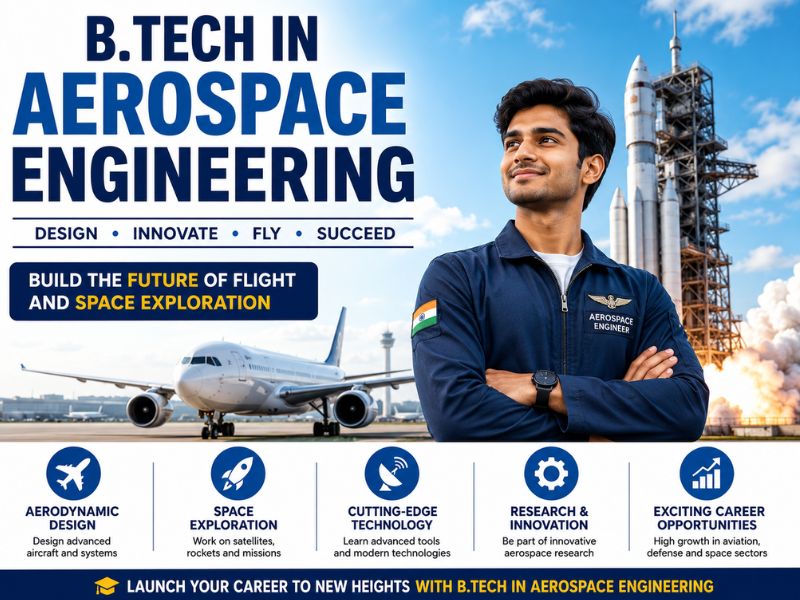
Aerospace Engineering sits at the intersection of two of the world's fastest-growing * — aviation and space. With India's defence, satellite, and commercial aviation sectors expanding rapidly, a B Tech in Aerospace Engineering has moved from a niche specialisation to one of the most sought-after engineering branches. This guide covers everything you need to know about pursuing B.Tech in Aerospace Engineering in India for the 2026-27 admission cycle — from eligibility and fees to top colleges, salaries, and entrance exam schedules.
B.Tech in Aerospace Engineering is a 4-year undergraduate program focused on the design, development, testing, and maintenance of aircraft, spacecraft, satellites, missiles, and related systems. The discipline is often split into two closely related streams: Aeronautical Engineering, which deals primarily with aircraft operating within Earth's atmosphere, and Astronautical Engineering, which focuses on spacecraft and systems operating beyond it. Most Indian B.Tech programs use "Aerospace Engineering" as an umbrella term covering both.
Aerospace Engineering as a discipline is taught at roughly 174 B.Tech-level colleges in India, of which around 24 are government institutions and the rest are private. The field's reputation in India is shaped disproportionately by a small set of top government colleges — IIT Bombay, IIT Madras, IIT Kanpur, IIT Kharagpur, and the specialised space-focused IIST Thiruvananthapuram — alongside a smaller cluster of private universities. Unlike Computer Science or Mechanical Engineering, Aerospace Engineering has comparatively fewer seats nationwide, which keeps cutoffs and admission competition tight, particularly at the IITs and IIST.
The subject blends physics-heavy theory (aerodynamics, propulsion, structures) with hands-on lab and project work, and most top colleges run dedicated wind tunnels, flight simulation labs, and propulsion test facilities to support this. Many institutes also maintain direct collaborations with ISRO, DRDO, HAL, and global aerospace majors, which shape both the curriculum and the placement pipeline.
Duration: 4 years (8 semesters); some institutes like IIST also offer a 5-year Dual Degree (B.Tech + M.Tech)
Core subjects: Aerodynamics, Flight Mechanics, Propulsion (Aircraft and Rocket), Aircraft Structures, Spacecraft Design, Avionics, Orbital Mechanics, Control Systems, Composite Materials
Specialisation tracks at advanced stages: Aerodynamics, Aerospace Structures, Propulsion, Avionics/Guidance & Control, Space Technology
Practical components: Wind tunnel experiments, CFD (Computational Fluid Dynamics) simulations, flight simulators, propulsion test rigs, and a mandatory final-year design/research project
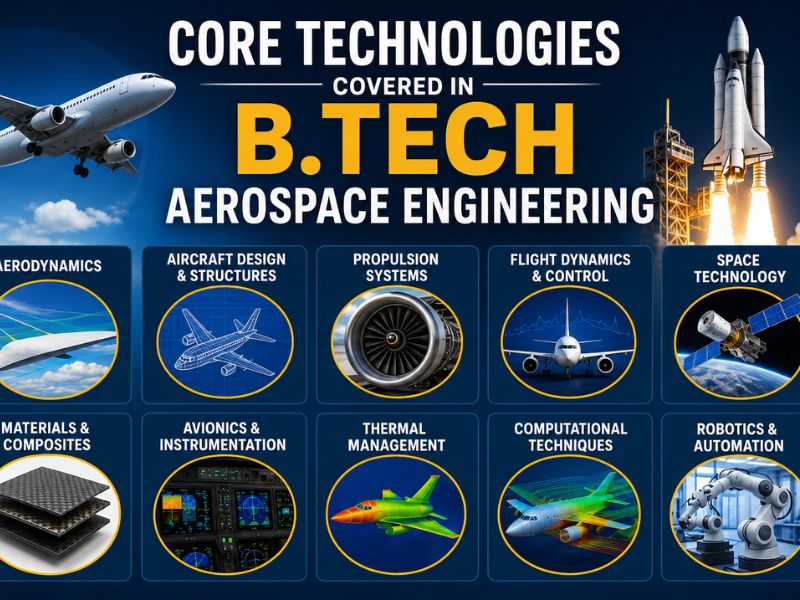
Computational Fluid Dynamics (CFD) — simulating airflow and aerodynamic behaviour
Finite Element Analysis (FEA) — structural stress and load analysis for airframes and spacecraft
Propulsion Systems — jet engines, rocket propulsion, and emerging electric/hybrid propulsion
Avionics and Control Systems — flight control, navigation, and guidance systems
Composite Materials Engineering — lightweight, high-strength materials used in modern airframes
Satellite and Orbital Mechanics — trajectory design, satellite systems, and space mission planning
Unmanned Aerial Systems (UAS/Drones) — a rapidly growing specialisation area at many colleges
Digital Twin and Simulation Tools — increasingly used for design validation before physical prototyping
Eligibility (most colleges): Pass Class 12 with Physics, Chemistry, and Mathematics (PCM), scoring at least 75% aggregate (65% for SC/ST/PwD) at IITs and IIST; many private universities accept 45-60% aggregate.
Fee structure overview for 2026-27:
College Type | Total 4-Year Fees (Approx.) |
IITs | ₹8-10 lakh |
IIST Thiruvananthapuram | ₹5.5-6.25 lakh (tuition only, excluding hostel) |
NITs | ₹5-6.5 lakh |
Top private universities (SRM, SASTRA, Chandigarh University) | ₹8-15 lakh |
Mid-tier private colleges | ₹3-8 lakh |
Government colleges offer income-based fee waivers: 100% tuition waiver for families earning under ₹1 lakh/year, and partial (2/3rd) waivers for those earning ₹1-5 lakh/year, with full waivers for SC/ST/PwD candidates at IITs.
IITs: JEE Advanced rank, followed by JoSAA counselling. Aerospace Engineering cutoffs at top IITs are notably tighter than at many other branches due to limited seats — IIT Bombay's Aerospace program closed around AIR 2,305 (Other State General) in the most recent cycle, IIT Madras around AIR 2,749, IIT Kanpur around AIR 3,550, and IIT Kharagpur around AIR 4,487
IIST Thiruvananthapuram: JEE Advanced score (a separate application is required on the IIST portal; it is not part of JoSAA), typically requiring a rank within the top 10,000-13,000
NITs (e.g., NIT Delhi): JEE Main rank through JoSAA; Aerospace cutoff around AIR 11,260 (General) in recent cycles
Private universities: JEE Main score, or the institute's own entrance exam (SRMJEEE, SASTRA's SASTRA-CGPA route, CUCET for Chandigarh University, COMEDK UGET or KCET for several Karnataka-based colleges), often combined with a minimum Class 12 percentage requirement
1. Appear for JEE Main (January and April sessions) to qualify for JEE Advanced or to apply directly to NITs/private universities.
2. Appear for JEE Advanced (mid-to-late May) if targeting IITs or IIST.
3. Apply separately to IIST via its own online admission portal after JEE Advanced results — IIST does not participate in JoSAA.
4. Register for JoSAA counselling for IITs and NITs; fill branch and institute preferences across multiple rounds.
5. Apply to private universities through their respective entrance exams or direct JEE Main-based counselling.
6. Complete document verification and seat acceptance fee payment, then report to campus.
Exam | Tentative Date |
JEE Main 2027 Session 1 | Last week of January 2027 |
JEE Main 2027 Session 2 | First week of April 2027 |
JEE Advanced 2027 | Mid-to-late May 2027 |
IIST Online Admission Portal Registration | Late May–June 2027 (post JEE Advanced result) |
JoSAA Counselling 2027 | June–July 2027 |
SRMJEEE / SASTRA admission / CUCET | March–May 2027 (institute-specific) |
JEE Advanced AIR under 2,500-3,000: IIT Bombay, IIT Madras Aerospace
AIR 3,000-5,000: IIT Kanpur, IIT Kharagpur Aerospace
AIR up to ~10,000-13,000 (separate IIST application): IIST Thiruvananthapuram
AIR up to ~11,000-15,000 via JoSAA: NIT Delhi and other NITs offering Aerospace/Aeronautical programs
JEE Main percentile 80-95 (no JEE Advanced needed): Top private universities — SRM, SASTRA, Chandigarh University, KIIT
JEE Main percentile below 80 or state-level exams: Mid-tier private colleges via COMEDK UGET, KCET, or direct admission routes
1. IIT Bombay (Mumbai)
Ranked the No. 1 college for Aerospace Engineering in India by multiple ranking agencies. The Aerospace Engineering Department is known for strength in aerodynamics, propulsion, and structures, with close ties to the Indian aerospace and defence sector.
Cutoff (JEE Advanced AIR, General): Around 2,305
Recruiters: Boeing, Airbus, HAL, DRDO, ISRO, along with general-sector recruiters like Uber, Microsoft, Bajaj
2. IIT Madras (Chennai)
Strong research output in aerospace structures and propulsion, supported by IIT Madras's broader research-park ecosystem.
Cutoff (JEE Advanced AIR, General): Around 2,749
Recruiters: Samsung, Amazon, Flipkart, alongside core aerospace and defence recruiters
3. IIT Kanpur (Kanpur)
One of the oldest and most respected Aerospace Engineering departments in India, with strong placement outcomes specific to the branch.
Highest package recorded: Around ₹22 LPA for Aerospace graduates, with recruiters including Microsoft, Dr Reddy's, Schlumberger, and Futures First
Total fees: Among the lowest of all IITs for this branch, around ₹8-9 lakh
4. IIT Kharagpur (West Bengal)
India's oldest IIT, with a long-established Aerospace Engineering department and the country's largest aerospace-related lab infrastructure among IITs.
Cutoff (JEE Advanced AIR, General): Around 4,487
Recruiters: Ford, Amazon, Wipro, ICICI Bank, plus core aerospace and defence organisations
5. IIT Hyderabad (Telangana)
A newer-generation IIT that has rapidly built a respected Aerospace Engineering program with modern lab infrastructure and growing research output.
Distinct strength: Strong integration with emerging aerospace technologies, including UAVs and advanced materials research
6. IIST Thiruvananthapuram (Kerala)
Asia's first dedicated space university, established in 2007 under the Department of Space, Government of India, is the most distinctive institute on this list for students specifically targeting a career with ISRO.
Total fees: Around ₹5.5-6.25 lakh tuition for 4 years (excluding hostel, which adds roughly ₹3.87 lakh)
Seats: Around 60-75 for Aerospace Engineering
Admission: JEE Advanced score via a separate IIST application (not through JoSAA)
Placement: Students with a CGPA of 7.5+ become eligible for direct ISRO Scientist/Engineer-SC recruitment, typically absorbing 60-70 students per batch; median package around ₹11.6 LPA, with the highest recorded package around ₹21.5 LPA; other recruiters include Texas Instruments, Skyroot Aerospace, Agnikul Cosmos, Analogue Devices, and Bosch
Distinct strength: Direct linkage to ISRO missions, MoUs with Caltech and Cambridge, and a top-sponsorship route for an intensive program at Caltech
7. NIT Delhi
The leading NIT for Aerospace/Aeronautical Engineering, offering a strong balance of affordability and placement outcomes.
Cutoff (JEE Advanced/Main equivalent, General): Around AIR 11,260
Total fees: Among the most affordable options on this list, around ₹5-6 lakh
8. IIEST Shibpur (West Bengal)
One of India's oldest technical institutes, offering Aerospace Engineering with a rigorous, research-oriented curriculum and advanced computational labs.
Distinct strength: Strong alumni-funded scholarship network and consistent industry-academia collaboration
9. DIAT Pune (Defence Institute of Advanced Technology)
A specialised institute under the Ministry of Defence, focused on defence-oriented aerospace and allied technologies — a strong fit for students aiming at DRDO and defence-sector careers.
Distinct strength: Direct alignment with India's defence research ecosystem and DRDO recruitment pathways
10. Visvesvaraya Technological University (Karnataka)
A major state technical university offering Aerospace Engineering through several affiliated colleges, with comparatively accessible cutoffs and growing industry tie-ups in Karnataka's aerospace and defence manufacturing corridor.
1. SRM Institute of Science and Technology (Kattankulathur, Chennai)
One of the most established private options for Aerospace Engineering, with design-oriented projects and strong interdisciplinary electives.
Total fees: Among the higher end for this branch, around ₹15 lakh for the full program
Admission: SRMJEEE or JEE Main score
2. SASTRA University (Thanjavur, Tamil Nadu)
NIRF is ranked among the top private institutes for Aerospace Engineering, blending classroom learning with simulation-based training.
Distinct strength: Strong industry internship pipeline and a steadily improving NIRF rank
3. Chandigarh University (Punjab)
A fast-growing private university with a large Aerospace Engineering cohort and competitive placement statistics relative to its fee level.
Total fees: Around ₹8 lakh for the full program
Admission: CUCET
4. KIIT University (Bhubaneswar, Odisha)
A consistently strong private placement performer, with Aerospace Engineering benefiting from KIIT's broader manufacturing and automotive recruiter base.
5. Manipal Institute of Technology (Karnataka)
Offers Aerospace Engineering with reasonable fees relative to other private options and strong international exposure through the MAHE ecosystem.
Admission: MET or JEE Main score
6. PEC Chandigarh (Punjab Engineering College)
Recognised as a top private Aerospace Engineering destination by several ranking agencies, with comparatively moderate fees.
Total fees: Around ₹7.7 lakh
7. RV College of Engineering (Bangalore)
A highly reputed private college in Karnataka with a strong Aerospace Engineering program and close industry connections to Bangalore's aerospace manufacturing cluster.
Admission: Primarily merit-based; limited management quota and NRI seats available
8. Amrita Vishwa Vidyapeetham (Coimbatore)
Offers Aerospace Engineering with strong lab infrastructure and a research-driven curriculum, admitting students via its own AEEE exam.
9. Vellore Institute of Technology (Vellore/Chennai)
While better known for CSE, VIT's Aerospace program benefits from the university's large recruiter network and flexible FFCS academic structure.
Admission: VITEEE
10. Alliance University (Bangalore)
A growing private option with comparatively accessible fees and a developing Aerospace Engineering placement pipeline.
Total fees: Around ₹8 lakh for the full program
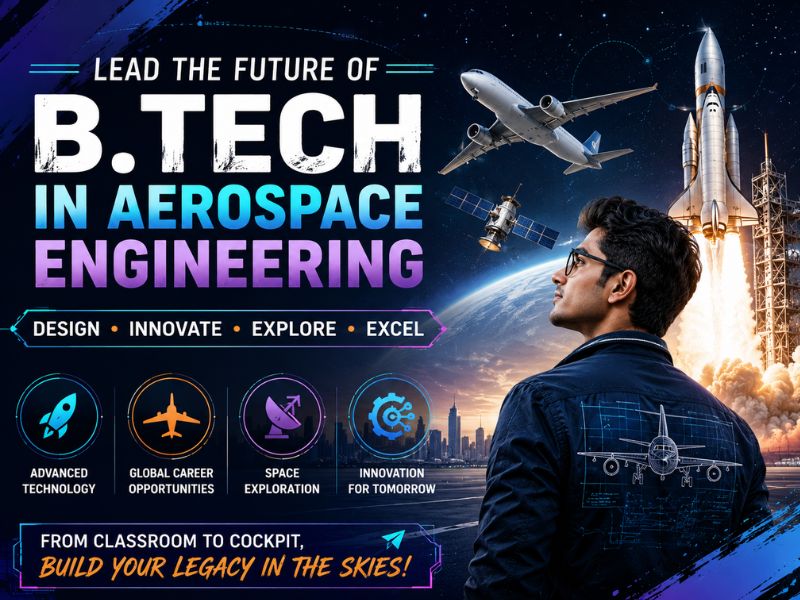
India's aerospace sector is entering a period of structural growth, driven by the rapid expansion of private space companies (Skyroot Aerospace, Agnikul Cosmos), increased government investment in defence manufacturing under Make in India, and ISRO's growing mission cadence. Drone technology, electric propulsion, reusable launch vehicles, and AI-assisted design and simulation are reshaping what aerospace engineers do day to day. Graduates entering the field today are increasingly expected to be fluent not just in classical aerodynamics and structures, but also in computational tools, systems engineering, and emerging propulsion technologies — a shift that top colleges are gradually building into their curricula.
IITs: Branch-specific placements vary, but IIT Kanpur has recorded the highest Aerospace package around ₹22 LPA; institute-wide IIT averages for core branches typically range from ₹15-25 LPA
IIST Thiruvananthapuram: Median package around ₹11.6 LPA, with the highest recorded offer around ₹21.5 LPA; students recruited directly by ISRO typically start around ₹10 LPA as Scientist/Engineer-SC
NITs: Average packages typically in the ₹8-15 LPA range for Aerospace/Aeronautical graduates
Top private universities: Average packages generally range from ₹4-10 LPA, with top performers at SRM, SASTRA, and similar institutes crossing ₹15-20 LPA
Government/PSU/defence roles (ISRO, DRDO, HAL): Often slightly lower starting cash salaries than top private-sector offers, but with significant long-term job security, research opportunities, and additional government benefits
IIST Thiruvananthapuram stands out as the strongest combination of low fees (~₹5.5-6.25 lakh tuition) and a near-guaranteed pathway to a stable, well-paying government career via ISRO for qualifying students. Among NITs, NIT Delhi offers a similarly strong fee-to-outcome ratio. Among private options, Chandigarh University and PEC Chandigarh are frequently cited for offering relatively low fees alongside reasonable placement consistency compared to costlier private alternatives like SRM.
IIST Thiruvananthapuram: Around ₹5.5-6.25 lakh tuition for 4 years — among the lowest of any specialised aerospace program in India
NITs: Around ₹5-6.5 lakh total
IIT Kanpur: Around ₹8-9 lakh, the lowest among the major IITs for this branch
State government colleges (via Visvesvaraya Technological University and similar state universities): Often under ₹3-5 lakh total
Colleges with Direct Admission
True merit-free direct admission is rare for Aerospace Engineering, given its limited seats, but a few pathways exist:
Several private universities (RV College of Engineering, Alliance University, and others) offer limited management quota or NRI/supernumerary seats outside the standard entrance process
A handful of state-level private colleges admit students directly based on Class 12 percentage for Aerospace/Aeronautical programs, particularly in less competitive locations.s
SRM Institute of Science and Technology — SRMJEEE
Chandigarh University — CUCET
Amrita Vishwa Vidyapeetham — AEEE
VIT — VITEEE
Several Karnataka-based colleges (RV College of Engineering and others) — COMEDK UGET or KCET
Note: IIST Thiruvananthapuram uses JEE Advanced scores but requires a separate application outside JoSAA — effectively its own admission process layered on top of a shared exam
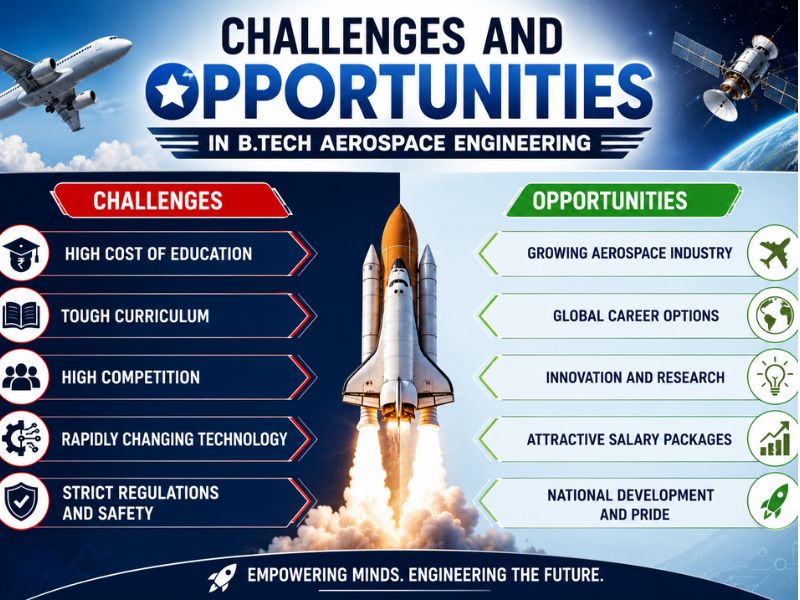
Challenges: Aerospace Engineering has far fewer seats and recruiters compared to mainstream branches like CSE or Mechanical, which means placement outcomes — outside a small set of top institutes — can be inconsistent. Many graduates from lower-ranked colleges end up taking non-core IT or analytics roles rather than aerospace-specific positions, simply because aerospace-specific recruiters concentrate heavily around IITs, NITs, and IIST. The field also demands sustained academic rigour in mathematics and physics throughout the program.
Opportunities: India's space economy is expanding rapidly with the rise of private players like Skyroot Aerospace and Agnikul Cosmos alongside ISRO's growing mission portfolio. Defence modernisation, UAV/drone technology, and the global push toward sustainable aviation (electric and hybrid propulsion) are creating new specialised career tracks. Graduates from top institutes also have strong access to international opportunities with Boeing, Airbus, and other global aerospace majors.
Aerospace Engineering is a strong fit if you have a genuine interest in flight, space systems, and applied physics, and are prepared for a curriculum that is more mathematically and conceptually intensive than several other engineering branches. It particularly rewards students who can secure a seat at a top institute (IITs, IIST, or a leading NIT), where recruiter access and research opportunities are concentrated. If your primary interest is software, general-purpose engineering flexibility, or maximising placement breadth, a broader branch like Computer Science or Mechanical Engineering may offer more options, since core aerospace roles remain comparatively limited outside the top tier of colleges.
Institute | NIRF Engineering Rank |
IIT Madras | 1 |
IIT Bombay | 3 |
IIT Kanpur | 4 |
IIT Kharagpur | 6 |
SRM University Chennai | 28 |
SASTRA University | 34 |
IIEST Shibpur | 35 |
Chandigarh University | 38 |
KIIT University | 39 |
IIST Thiruvananthapuram | 48-61 (varies by year) |
Return on Investment (ROI)
IITs: Exceptional ROI given fees of ₹8-10 lakh against core placement packages frequently exceeding ₹15-22 LPA
IIST Thiruvananthapuram: Among the best ROI of any specialised engineering program in India — low fees (~₹6 lakh) combined with a realistic pathway to stable ISRO employment
NITs: Strong ROI with fees around ₹5-6.5 lakh against average placements of ₹8-15 LPA
Top private universities: Moderate ROI — fees of ₹8-15 lakh against average placements typically in the ₹4-10 LPA range, making careful college selection particularly important in this branch
Conclusion
A B.Tech in Aerospace Engineering offers a focused, high-impact career path for students drawn to flight and space systems, but outcomes vary sharply by institute. The IITs, IIST Thiruvananthapuram, and a handful of strong NITs and private universities concentrate most of the sector's research opportunities and recruiter access, making institute choice especially important in this branch. With India's space and defence sectors expanding rapidly, students who secure a seat at a top-tier college and build strong computational and design skills are well-positioned for a rewarding career in this field.
Frequently Asked Questions (FAQs)
1. Which is the best college for B.Tech Aerospace Engineering in India?
IIT Bombay is widely regarded as the top college for Aerospace Engineering in India, followed closely by IIT Madras, IIT Kanpur, and IIT Kharagpur.
2. Is IIST better than IITs for Aerospace Engineering? IIST Thiruvananthapuram is not "better" in a general ranking sense, but it offers something IITs don't: a near-direct, structured pathway into ISRO for students meeting the CGPA criteria. For students specifically targeting a space-sector career, IIST is often considered a stronger fit despite ranking lower on overall NIRF metrics.
3. What is the difference between Aerospace and Aeronautical Engineering? Aerospace Engineering is the broader discipline covering both aircraft and spacecraft systems, while Aeronautical Engineering specifically focuses on aircraft operating within Earth's atmosphere. Most Indian B.Tech programs use "Aerospace Engineering" as the umbrella term.
4. Can I get a B.Tech in Aerospace Engineering without JEE Advanced? Yes. NITs use JEE Main scores, and private universities like SRM, SASTRA, VIT, and Chandigarh University use their own entrance exams or accept JEE Main scores directly.
5. What is the average salary after B.Tech in Aerospace Engineering? At top IITs, packages can reach ₹15-25 LPA for core aerospace roles; at IIST, the median is around ₹11.6 LPA with strong ISRO absorption; at mid-tier private colleges, average packages typically range from ₹4-10 LPA.
6. Is Aerospace Engineering a good career choice in India right now? Yes — driven by ISRO's expanding mission cadence, the rise of private space companies, and growing defence-sector investment, demand for aerospace engineers is rising, though it remains a more specialised and seat-limited field than mainstream branches like CSE.
7. Does IIST Thiruvananthapuram require JoSAA counselling? No. IIST uses JEE Advanced scores but requires candidates to apply separately through its own admission portal — it does not participate in JoSAA counselling.