

Efficiently locate colleges, exams, or coachings with our intuitive search modal.
0 results
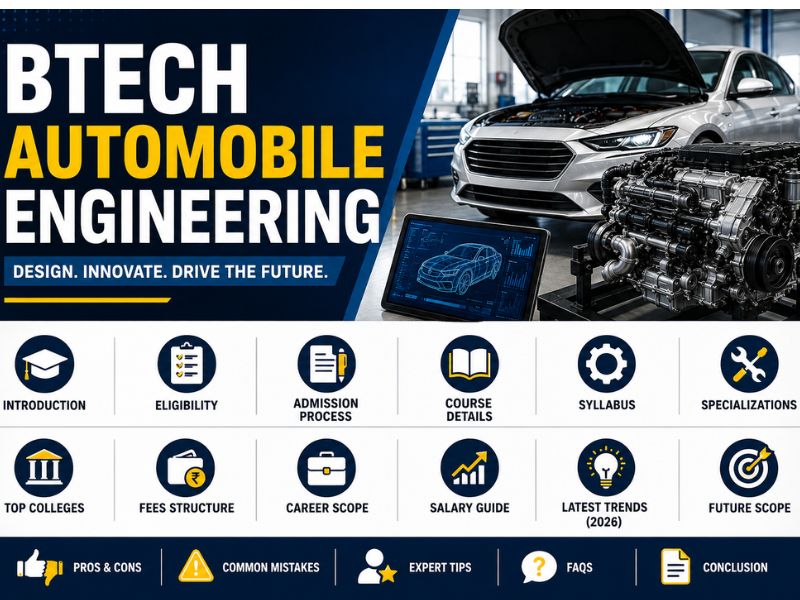
The automobile industry is rapidly transforming with electric vehicles, smart mobility solutions, autonomous driving technologies, and sustainable transportation systems. As automotive technology evolves, the demand for engineers who can design, develop, manufacture, and improve modern vehicles is increasing significantly.
B.Tech. Automobile Engineering is one of the most exciting engineering disciplines for students interested in vehicles, mechanical systems, manufacturing technologies, and transportation innovation. The program combines engineering fundamentals with advanced automotive technologies to prepare students for careers in one of the world’s largest industries.
This complete guide covers everything about BTech Automobile Engineering, including eligibility, admission process, fees, syllabus, career scope, salary, placements, specialisations, future opportunities, and latest industry trends.
BTech Automobile Engineering is a 4-year undergraduate engineering program focused on vehicle design, manufacturing, testing, maintenance, production systems, automotive electronics, and transportation technologies.
The course combines mechanical engineering concepts with specialised automotive knowledge to develop skilled engineers for modern vehicle industries.
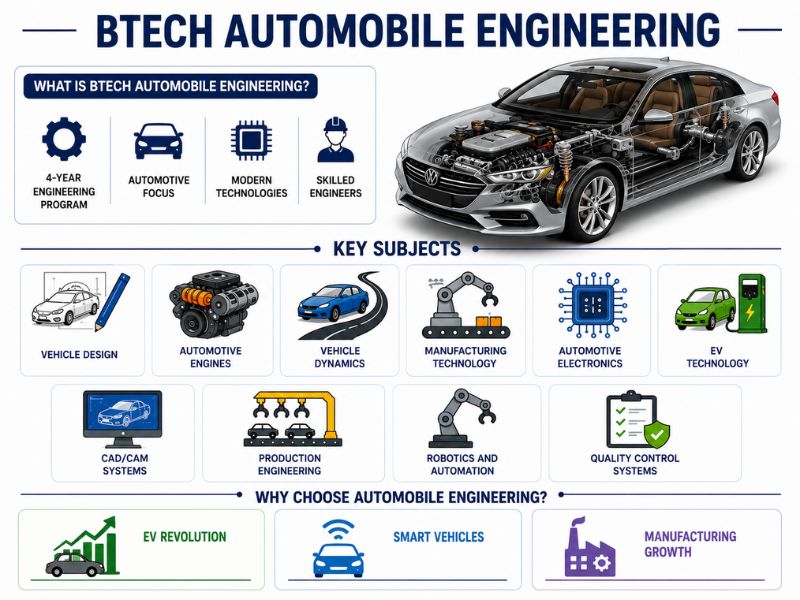
Vehicle Design and Development teaches students how automobiles are designed, tested, and manufactured according to safety, performance, and efficiency standards. Students learn about designing modern vehicles using engineering principles and advanced technologies.
This subject focuses on the working principles, performance, and maintenance of automobile engines. Students gain knowledge about internal combustion engines, fuel systems, engine components, and modern powertrain technologies used in vehicles.
Vehicle Dynamics helps students understand how vehicles behave during acceleration, braking, cornering, and movement. This subject focuses on improving vehicle stability, safety, comfort, and overall driving performance.
Manufacturing Technology teaches students how automobile components and vehicles are produced using modern industrial processes. Students learn about machining, production systems, assembly techniques, and industrial manufacturing practices.
Modern vehicles rely heavily on electronic systems for safety, performance, and automation. Automotive Electronics helps students understand sensors, control systems, embedded technologies, and smart electronic components used in vehicles.
Electric Vehicle Technology focuses on battery systems, electric motors, charging infrastructure, and sustainable transportation solutions. As EV adoption grows rapidly, this specialisation has become one of the most important areas in automobile engineering.
CAD/CAM systems help students learn computer-based vehicle designing and manufacturing processes. These tools are widely used in the automobile industry for creating accurate designs, simulations, and production models.
Production Engineering focuses on efficient manufacturing systems, industrial operations, process optimisation, and quality improvement techniques used in automobile production facilities.
Robotics and Automation teach students how modern manufacturing plants use automation systems, robotic machines, and intelligent production technologies to improve efficiency and productivity.
Quality Control Systems help students understand how automobile companies maintain product quality, safety standards, and manufacturing accuracy through testing and inspection processes.
The rapid growth of electric vehicles is creating strong demand for professionals with knowledge of EV systems, battery technologies, charging infrastructure, and sustainable mobility solutions.
Modern vehicles are increasingly adopting AI, automation, connected systems, and smart technologies. This shift toward intelligent mobility is creating new career opportunities in automobile engineering.
The expansion of automobile manufacturing, industrial automation, and production facilities continues to create strong career opportunities for skilled engineering graduates.
The global automobile industry is constantly evolving through technological advancements, sustainable transportation solutions, and innovation-driven manufacturing systems, creating long-term career growth opportunities.
Automobile Engineering prepares students for careers in vehicle technology, manufacturing systems, electric mobility, automation, and future transportation technologies. With increasing demand for EVs, smart vehicles, and industrial innovation, the field continues to offer strong career opportunities globally.B.Tech.
Automobile Engineering: Course Highlights
BTech Automobile Engineering is a 4-year undergraduate program that focuses on the design, development, manufacturing, and maintenance of vehicles such as cars, bikes, trucks, and electric vehicles. The course combines concepts of mechanical engineering, automotive electronics, and vehicle technology to provide students with industry-relevant skills.
Students study subjects like Automotive Engines, Vehicle Dynamics, Thermodynamics, Manufacturing Processes, Automobile Design, and Electric Vehicle Technology. The program also includes practical training, workshops, and industry projects to enhance technical knowledge.
Graduates can find opportunities in automobile manufacturing companies, EV startups, research organisations, and automotive service sectors. Popular job roles include Automobile Engineer, Design Engineer, Production Engineer, and Quality Engineer. With the rapid growth of the automotive and electric vehicle industry, BTech Automobile Engineering offers strong career prospects and excellent opportunities for professional growth.
B.Tech. Automobile Engineering is becoming increasingly popular because the automobile industry is rapidly evolving with electric vehicles, smart mobility solutions, automation, and sustainable transportation technologies. This field provides students with opportunities across manufacturing, vehicle design, research, production systems, and future mobility innovations.
Students who are passionate about vehicles, technology, mechanical systems, and industrial innovation often find Automobile Engineering to be a strong career option with long-term growth potential.
The rapid expansion of electric vehicles has created strong demand for engineers with knowledge of battery systems, electric powertrains, charging infrastructure, and sustainable mobility solutions. As governments and industries continue investing in EV technology, career opportunities continue expanding.
Automobile Engineering plays an important role in manufacturing industries where engineers work on production systems, assembly operations, quality management, and industrial automation. The continuous growth of manufacturing creates a strong demand for skilled professionals.
The automobile sector is one of the largest industries globally and provides opportunities across multiple countries. Engineers can explore careers in vehicle manufacturing, automotive technology, transportation systems, and mobility companies worldwide.
Modern automobile engineering involves advanced technologies such as AI systems, autonomous vehicles, electric mobility, robotics, and smart manufacturing. Students entering this field become part of an industry driven by continuous innovation.
Graduates can work across multiple domains, including vehicle manufacturing, automotive design, testing, quality control, production management, electric vehicle systems, and mobility solutions. The field offers flexibility across both technical and management roles.
Automobile companies continuously invest in research and development to improve vehicle efficiency, safety systems, fuel technologies, and future mobility solutions. Engineers with strong technical skills often find opportunities in advanced R&D roles.
The transition from traditional fuel-based vehicles toward electric mobility is creating major technological changes within the automobile sector. This transformation is increasing the demand for engineers with modern automotive skills.
Manufacturing automation, robotics, AI integration, and smart production systems are creating new job roles in automotive engineering and industrial operations.
Governments and industries are focusing heavily on sustainable transportation solutions, green mobility systems, and energy-efficient vehicles, creating strong future demand for automobile engineers.
B.Tech. Automobile Engineering is an excellent choice for students interested in vehicles, manufacturing systems, innovation, and emerging mobility technologies. With growth in electric vehicles, automation, and smart transportation systems, the field offers strong career opportunities and long-term industry relevance.
The BTech Automobile Engineering syllabus is designed to provide students with a strong foundation in vehicle design, manufacturing, maintenance, and emerging automotive technologies. The curriculum typically includes subjects such as Engineering Mathematics, Engineering Mechanics, Thermodynamics, Fluid Mechanics, Automobile Engines, Vehicle Dynamics, Automotive Electronics, Manufacturing Technology, Automobile Design, Electric Vehicles, and Hybrid Vehicle Technology. Practical training, laboratory work, industrial visits, internships, and project-based learning are also important components of the program.
Some of the most recommended books for B.Tech. Automobile Engineering students are:
These books help students understand core automobile engineering concepts and prepare for academic studies, projects, and industry careers.
After completing B.Tech. Automobile Engineering graduates can explore various career opportunities in the automotive, manufacturing, electric vehicle (EV), and transportation sectors. The program equips students with the technical knowledge and practical skills required for designing, developing, testing, and maintaining modern vehicles.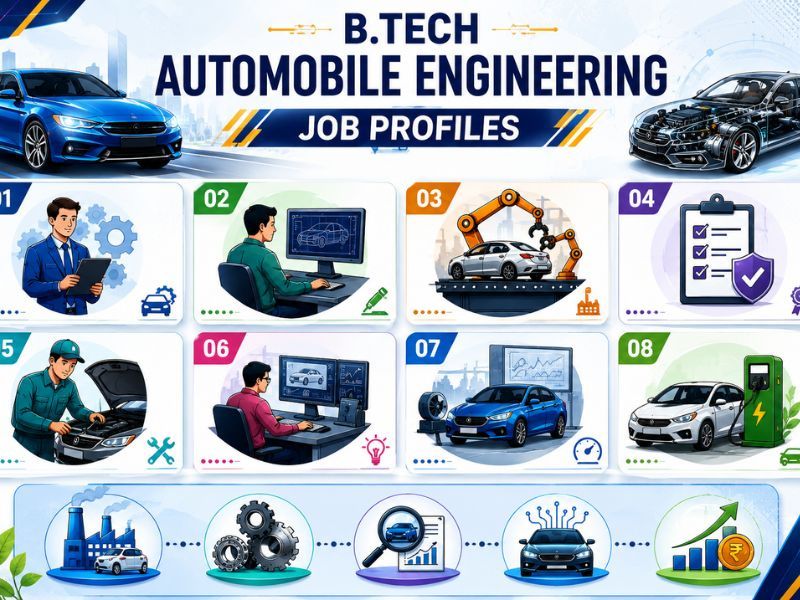
Some popular BTech Automobile Engineering job profiles include:
With the rapid growth of the automobile and EV industries, graduates can find employment in automobile manufacturers, component companies, research organisations, and automotive technology firms, offering excellent career growth and competitive salary packages.
Students who want to pursue BTech.h Automobile Engineering must meet certain academic and entrance requirements set by engineering colleges and universities. Since Automobile Engineering combines mechanical systems, manufacturing technologies, and vehicle design concepts, students should have strong fundamentals in science and mathematics.
Students must complete Class 12 from a recognised board with Physics, Chemistry, and Mathematics (PCM) as core subjects. These subjects build the technical foundation required for engineering concepts, problem-solving, and automobile systems.
Most colleges require students to secure minimum qualifying marks in higher secondary education. The required percentage may vary depending on the college, admission competition, and category-based eligibility criteria.
Many engineering institutions consider JEE Main scores for admission into Automobile Engineering programs. A good entrance score improves opportunities for admission into reputed engineering colleges.
Several states conduct engineering entrance examinations and centralised counselling processes for admission into government and private engineering institutions.
Many private universities conduct their own entrance exams or admission procedures for Automobile Engineering programs. These admission processes may include entrance tests, merit evaluation, or counselling.
Automobile Engineering requires students to analyse complex systems, understand technical problems, and create efficient engineering solutions. Analytical skills help students perform better in technical subjects.
Students should have an interest in machines, engines, vehicle systems, and mechanical concepts because Automobile Engineering heavily focuses on manufacturing and mechanical technologies.
Engineers regularly face technical challenges related to design, manufacturing, testing, and vehicle performance. Strong problem-solving skills help students handle engineering tasks effectively.
A genuine interest in automobiles, machinery, production systems, and emerging technologies helps students understand concepts more effectively and perform better academically.
Modern automobile engineering increasingly focuses on innovation, smart mobility, electric vehicles, and advanced transportation systems. Creative thinking helps students develop better engineering solutions.
The admission process for BTech Automobile Engineering generally follows entrance examinations, counselling procedures, and document verification. Students should carefully complete each step to secure admission into suitable colleges.
Students must complete higher secondary education with Physics, Chemistry, and Mathematics. Strong academic performance can improve admission opportunities in competitive colleges.
Admissions are generally based on engineering entrance examinations conducted at national, state, or university levels.
JEE Main is one of the most widely accepted engineering entrance exams for admission into Automobile Engineering programs across India.
Many state governments conduct centralised counselling processes where seats are allocated according to entrance rank and merit performance.
Private universities may conduct their own entrance tests or evaluation procedures depending on admission policies.
Students need to submit applications to selected engineering colleges and universities that offer Automobile Engineering programs. Students should compare fees, placements, infrastructure, and industry exposure before selecting colleges.
During counselling, seats are allotted based on merit rank, entrance exam scores, category reservation, and seat availability. Students should carefully select colleges during this stage.
After seat allotment, students must complete document verification and fee payment procedures to confirm their admission successfully.
BTech Automobile Engineering admission requires strong academic preparation, entrance exam performance, and careful college selection. Students with technical interest, creativity, and passion for vehicles can build strong careers in automobile manufacturing, electric mobility, and transportation technologies.
Government colleges offering BTech Automobile Engineering generally provide affordable education with comparatively lower tuition fees and a strong return on investment. The total fees in most government institutions usually range between ₹50,000 and ₹3 Lakhs for the complete program, making them a preferred option for students looking for quality education at a lower cost.
Private universities usually charge higher fees because they invest significantly in advanced infrastructure, modern laboratories, industry collaborations, practical learning facilities, and specialised automobile engineering equipment. The total fees in private colleges generally range between ₹3 Lakhs and ₹12 Lakhs, depending on facilities and reputation.
Government engineering colleges are often considered better for return on investment because of lower fees combined with good placement opportunities and strong academic quality. Students can often recover their education investment faster after graduation.
Modern automobile engineering programs increasingly include electric vehicle technology, battery systems, automotive electronics, and smart mobility infrastructure. Maintaining specialised EV laboratories and advanced equipment increases operational and infrastructure expenses for institutions.
Many colleges provide scholarships based on merit, entrance exam performance, academic scores, financial background, or category-based benefits. Scholarships can significantly reduce the overall cost of pursuing automobile engineering.
Engineering Mechanics provides students with the fundamentals of forces, motion, energy, and mechanical systems. This subject builds the technical foundation required for understanding vehicle design and engineering principles.
Thermodynamics focuses on heat transfer, energy conversion, engine performance, and power generation systems. It is one of the most important subjects for understanding automobile engines and vehicle performance.
Fluid Mechanics teaches students how liquids and gases behave under different conditions. This subject plays an important role in engine systems, aerodynamics, cooling systems, and fuel technologies.
Students learn about internal combustion engines, engine components, fuel systems, engine performance, and modern powertrain technologies used in vehicles.
Vehicle Dynamics focuses on how vehicles respond during acceleration, braking, turning, and road movement. Students learn concepts related to stability, safety, comfort, and driving performance.
Modern vehicles increasingly depend on electronic systems for safety, efficiency, and automation. This subject helps students understand sensors, control systems, embedded technologies, and electronic vehicle components.
Manufacturing Technology teaches industrial production processes used for automobile manufacturing, assembly systems, machining techniques, and production optimisation methods.
CAD/CAM helps students learn computer-based designing and manufacturing systems used in modern automobile production. These tools are essential for creating accurate vehicle designs and engineering simulations.
Electric Vehicle Systems focus on battery technologies, electric motors, charging systems, and sustainable transportation technologies that are transforming the automobile industry.
Students learn how robotics and automation improve manufacturing efficiency, production systems, and industrial operations in modern automobile manufacturing facilities.
Workshop training provides practical exposure to machines, tools, vehicle components, and engineering equipment to improve hands-on technical skills.
Industrial training allows students to gain real-world experience by working in manufacturing plants, automobile companies, and engineering organisations.
Vehicle testing helps students understand safety analysis, performance evaluation, quality assessment, and testing procedures used in automobile manufacturing.
Manufacturing laboratories provide practical exposure to industrial production systems, machining operations, assembly processes, and engineering technologies.
Projects and internships help students apply theoretical concepts in real industrial environments while improving technical knowledge, practical experience, and placement opportunities.
Electric Vehicle Technology
Electric Vehicle Technology is one of the fastest-growing specialisations in Automobile Engineering, focusing on battery systems, electric motors, charging infrastructure, and sustainable transportation solutions. As the automotive industry rapidly shifts toward electric mobility, demand for EV professionals continues to increase globally.
Automotive Design focuses on vehicle structure, aesthetics, performance optimisation, and engineering development. Students learn how modern vehicles are designed using advanced engineering principles and computer-aided design technologies.
Manufacturing Systems teaches students how automobile production processes operate efficiently through industrial automation, assembly systems, process optimisation, and production management techniques used in modern factories.
Vehicle Dynamics focuses on understanding vehicle behaviour during acceleration, braking, cornering, and overall movement. Students learn how engineers improve vehicle stability, performance, safety, and driving comfort.
Modern vehicles rely heavily on sensors, embedded systems, electronic control units, and smart technologies. Automotive Electronics helps students understand electronic systems used in advanced vehicles and intelligent transportation technologies.
Robotics and Automation teach students how intelligent machines, automated production systems, and industrial robotics improve manufacturing efficiency and modern automobile production processes.
Production Engineering focuses on improving manufacturing efficiency, production planning, quality control, industrial operations, and resource optimisation used within the automotive industry.
Sustainable Mobility focuses on environmentally friendly transportation solutions, energy-efficient vehicles, green technologies, and future mobility systems designed to reduce environmental impact.
Electric vehicles are transforming the automobile industry through cleaner transportation systems, advanced battery technologies, and reduced dependency on traditional fuels. EV technologies are creating significant career opportunities for future automobile engineers.
Autonomous driving technologies focus on self-driving systems, intelligent navigation, sensors, AI algorithms, and vehicle automation systems that are reshaping future transportation models.
Smart mobility systems integrate technology, connectivity, data analytics, and intelligent transportation networks to improve transportation efficiency, traffic management, and urban mobility solutions.
Artificial Intelligence is increasingly being integrated into transportation systems for predictive maintenance, intelligent driving assistance, traffic optimisation, and advanced vehicle decision-making systems.
Connected vehicles use internet-enabled technologies and communication systems to exchange information between vehicles, infrastructure, and digital platforms for improved safety and efficiency.
The automobile industry is increasingly adopting sustainable technologies, including energy-efficient vehicles, renewable energy integration, green manufacturing processes, and environmentally responsible transportation systems.
This institute is widely recognised for its strong engineering education, advanced research facilities, and industry collaborations. Automobile Engineering students benefit from modern laboratories, technical projects, and strong placement opportunities.
Known for quality technical education and strong academic infrastructure, this institution offers engineering programs with good industry exposure, research opportunities, and practical learning environments.
This university is considered one of the most popular destinations for engineering education due to its affordable fees, experienced faculty, and strong technical curriculum focused on industrial requirements.
DTU is known for its strong engineering programs, practical learning approach, research activities, and excellent placement opportunities across manufacturing and technology sectors.
This university is highly regarded for engineering education, affordable fee structure, and strong academic reputation. Students often choose it for its research-oriented environment and industry connections.
VIT offers modern infrastructure, advanced laboratories, industry partnerships, and strong placement support, making it a popular choice among engineering aspirants.
SRM focuses heavily on practical learning, industry exposure, internships, and technology-driven education, which helps students build strong technical foundations.
This university is known for strong academic programs, international exposure, research opportunities, and modern engineering infrastructure supporting technical education.
UPES is recognised for specialised industry-oriented programs, including automotive, energy, and engineering technologies, with a strong focus on practical training.
Chandigarh University offers modern facilities, industry partnerships, placement support, and skill-based learning environments that attract many engineering students.
Selecting the right Automobile Engineering college should depend not only on rankings but also on factors such as infrastructure, practical exposure, placements, industry collaborations, laboratories, internship opportunities, and overall return on investment.
Automobile manufacturers are among the largest employers for Automobile Engineering graduates. Engineers work in vehicle production, design, testing, quality control, manufacturing operations, and product development within automobile companies.
Electric vehicle companies are rapidly expanding due to increasing demand for sustainable transportation solutions. Graduates with knowledge of battery technology, electric powertrains, and EV systems can find strong career opportunities in this sector.
Manufacturing industries hire automobile engineers for production management, industrial operations, process optimisation, and automation systems. The manufacturing sector continues to create large-scale employment opportunities for engineering graduates.
Research and development centres focus on innovation, vehicle testing, performance improvement, safety technologies, and future mobility solutions. Graduates interested in innovation and advanced engineering often pursue R&D careers.
Many automobile engineering graduates also find opportunities in aerospace industries because of similarities in manufacturing processes, design systems, materials engineering, and mechanical technologies.
Automation and robotics companies increasingly hire automobile engineers because modern manufacturing systems rely heavily on industrial automation, intelligent machines, and robotic production systems.
The rapid growth of mobility startups focusing on electric transportation, smart mobility solutions, vehicle-sharing platforms, and sustainable transportation is creating new opportunities for automobile engineering graduates.
Automobile Engineers work on designing, testing, manufacturing, and improving vehicle systems to increase performance, safety, and efficiency within the automotive industry.
Vehicle Design Engineers focus on developing vehicle structures, components, systems, and overall vehicle architecture using modern design software and engineering technologies.
Production Engineers manage manufacturing operations, assembly processes, industrial systems, and production efficiency to improve automobile manufacturing performance.
Quality Engineers ensure that vehicle components, manufacturing processes, and finished products meet required quality standards, safety regulations, and performance requirements.
EV Engineers specialize in electric mobility technologies, including battery systems, charging infrastructure, electric motors, and sustainable transportation solutions.
Automotive Consultants help organisations improve manufacturing systems, vehicle technologies, production efficiency, and business operations through technical expertise and industry knowledge.
Manufacturing Engineers focus on production optimisation, industrial systems, automation technologies, and efficient manufacturing practices used in automobile production.
Service Engineers work on vehicle maintenance, diagnostics, repair systems, and technical support services to ensure the proper functioning of automotive systems.
The rapid expansion of electric vehicles is creating significant employment opportunities for graduates with knowledge of battery technologies, EV systems, and sustainable transportation solutions.
Manufacturing continues to remain one of the largest employment sectors for automobile engineers due to increasing industrial production and growing transportation demand.
Automation technologies, robotics systems, AI integration, and smart manufacturing are creating new career opportunities beyond traditional automobile engineering roles.
Automobile Engineering offers strong career opportunities across manufacturing, electric mobility, automation, vehicle design, and future transportation systems. With rapid innovation in mobility technologies, the career scope continues to expand globally.
Freshers graduating with a BTech in Automobile Engineering generally receive starting salary packages ranging between ₹3 LPA and ₹7 LPA, depending on technical skills, college reputation, internships, certifications, and specialisation areas. Students with practical exposure and industry-relevant skills often secure better entry-level opportunities.
With growing industry experience, technical expertise, and specialised knowledge, automobile engineers can achieve salary packages ranging from ₹8 LPA to ₹20 LPA or even higher. Career growth largely depends on job role, industry segment, and technical specialisation.
Germany remains one of the strongest destinations for automobile engineers because of its globally recognised automotive industry, advanced manufacturing systems, and strong focus on engineering innovation. Professionals with specialised skills often find excellent career opportunities here.
The USA offers strong opportunities in automotive technology, electric mobility, manufacturing systems, robotics, and research-based engineering roles. Demand is increasing due to rapid growth in electric vehicles and smart mobility technologies.
Japan is known for advanced automobile manufacturing, robotics integration, and innovation-driven transportation systems. Engineers interested in automotive technology and production systems often explore opportunities in Japanese automotive companies.
Canada provides growing opportunities for automobile engineers due to increasing manufacturing activities, electric vehicle investments, and demand for skilled engineering professionals.
The UAE offers opportunities in automobile services, manufacturing support, industrial operations, and transportation infrastructure projects. Growing industrial investments continue to create demand for engineering professionals.
Strong technical knowledge in automotive systems, manufacturing processes, design software, and engineering concepts significantly influences salary growth and career progression.
Professionals with expertise in electric vehicles, battery technologies, charging infrastructure, and sustainable mobility systems often receive better salary opportunities due to rising market demand.
Practical industry experience plays a major role in salary growth because employers prefer candidates who can handle real-world engineering challenges and production environments effectively.
Hands-on technical skills gained through projects, industrial training, internships, and laboratory experience improve employability and increase earning potential.
Additional certifications in CAD tools, automation systems, EV technologies, robotics, manufacturing software, and industry technologies can improve career prospects and salary growth.
BTech Automobile Engineering offers strong salary potential with increasing opportunities in electric mobility, manufacturing, automation, and advanced transportation technologies. Students who develop technical expertise and practical skills often achieve faster career growth and higher earning potential.
Electric vehicles are transforming the automobile industry by reducing dependence on traditional fuel systems and promoting sustainable transportation. Increasing investments in battery technology, charging infrastructure, and electric mobility solutions are creating significant growth opportunities in the automotive sector.
Autonomous vehicles use artificial intelligence, sensors, cameras, and advanced computing systems to enable self-driving capabilities. These technologies are reshaping transportation systems and creating demand for engineers skilled in automation and intelligent mobility.
Smart mobility focuses on improving transportation efficiency through connected technologies, intelligent traffic systems, digital platforms, and data-driven transportation solutions. The future of urban transportation increasingly depends on smart mobility innovations.
Connected transportation systems allow vehicles, infrastructure, and digital networks to communicate with each other for improved safety, navigation, and operational efficiency. Connected vehicle technologies are becoming an important part of modern automotive development.
Artificial Intelligence is increasingly being integrated into vehicle systems for predictive maintenance, driver assistance, intelligent navigation, automation, and safety improvements. AI is becoming one of the major technologies shaping future automotive engineering.
Sustainable transportation focuses on developing environmentally friendly mobility solutions that reduce emissions and improve energy efficiency. Automobile companies are increasingly investing in green technologies and cleaner transportation systems.
The rapid adoption of electric vehicles is driving major expansion across automobile manufacturing, battery technologies, charging infrastructure, and sustainable transportation industries.
Artificial Intelligence is significantly changing how vehicles are designed, manufactured, operated, and maintained. AI-driven systems are creating smarter, safer, and more efficient transportation technologies.
Governments, industries, and consumers are increasingly focusing on sustainable transportation solutions. Green mobility is becoming a major priority as industries work toward reducing environmental impact and improving energy efficiency.
Automobile Engineering is rapidly evolving through electric mobility, artificial intelligence, automation, and sustainable transportation technologies. Students who develop skills in emerging automotive technologies will be better positioned for future career opportunities in this growing industry.
Automobile Engineering is expected to experience strong growth in the coming years because the transportation industry is rapidly shifting toward advanced technologies, electric mobility, automation, and intelligent transportation systems. The future of automobile engineering is becoming more technology-driven, creating new opportunities beyond traditional vehicle manufacturing.
The increasing adoption of electric vehicles is creating significant demand for engineers with expertise in battery technologies, electric powertrains, charging infrastructure, and sustainable transportation systems. As EV production continues expanding globally, career opportunities are expected to grow rapidly.
Smart transportation systems use digital technologies, intelligent infrastructure, and connected networks to improve traffic management, mobility efficiency, and transportation safety. These systems are creating new roles for engineers specialising in advanced automotive technologies.
Sustainable mobility focuses on environmentally friendly transportation systems that reduce emissions and improve energy efficiency. Growing investments in green mobility are increasing demand for automobile engineers with knowledge of sustainable technologies.
Modern vehicles increasingly rely on connectivity systems that allow communication between vehicles, infrastructure, and digital platforms. Connected vehicle technologies are becoming essential for improving safety, efficiency, and intelligent mobility solutions.
Automation is transforming automobile manufacturing and transportation systems through robotics, AI integration, smart factories, and autonomous technologies. Engineers with automation skills are expected to see strong career growth.
Many governments worldwide are actively supporting electric mobility through subsidies, infrastructure development, manufacturing incentives, and sustainability policies. These initiatives are accelerating growth within the automobile industry.
Automobile Engineering is becoming increasingly innovation-focused as industries adopt electric mobility, AI-powered systems, automation technologies, and sustainable transportation solutions. Students entering this field can expect opportunities across manufacturing, research, mobility technologies, smart transportation, and future automotive systems.
B.Tech. Automobile Engineering remains one of the most exciting engineering fields in 2026 due to rapid developments in electric vehicles, automation, AI, and sustainable transportation systems.
Students who combine strong technical knowledge with practical experience, internships, modern software skills, and EV expertise can build successful careers in automotive manufacturing, design, research, and future mobility solutions...
Yes, especially with growing EV demand.
4 years.
₹3–20 LPA+ depending on skills and experience.
It requires technical understanding and practical learning.
Electric Vehicle Technology and Automotive Electronics.

Get personalized college recommendations and scholarship opportunities